Beginner Crochet Tutorial: Your First Chain, Single Crochet, and a Finished Swatch
By the end you will hold the hook right, make a chain, work single crochet, and finish a 10 cm square in about 45 minutes.
A beginner's first crochet swatch usually takes 45 minutes, and most of that time goes into the first ten chain stitches.
Crochet is one loop pulled through another loop. That is the whole craft. The hard part is your hands, not your brain.
This guide walks you from the slip knot to a finished 10 cm square. No pattern reading, no counting charts, no buying a kit. Just yarn, a hook, and a few quiet minutes.
You need one hook, one ball of worsted yarn, and about 45 minutes. Learn the slip knot, the chain, and single crochet, and you can make a flat square that holds its shape. Everything else in crochet is a version of those three moves.
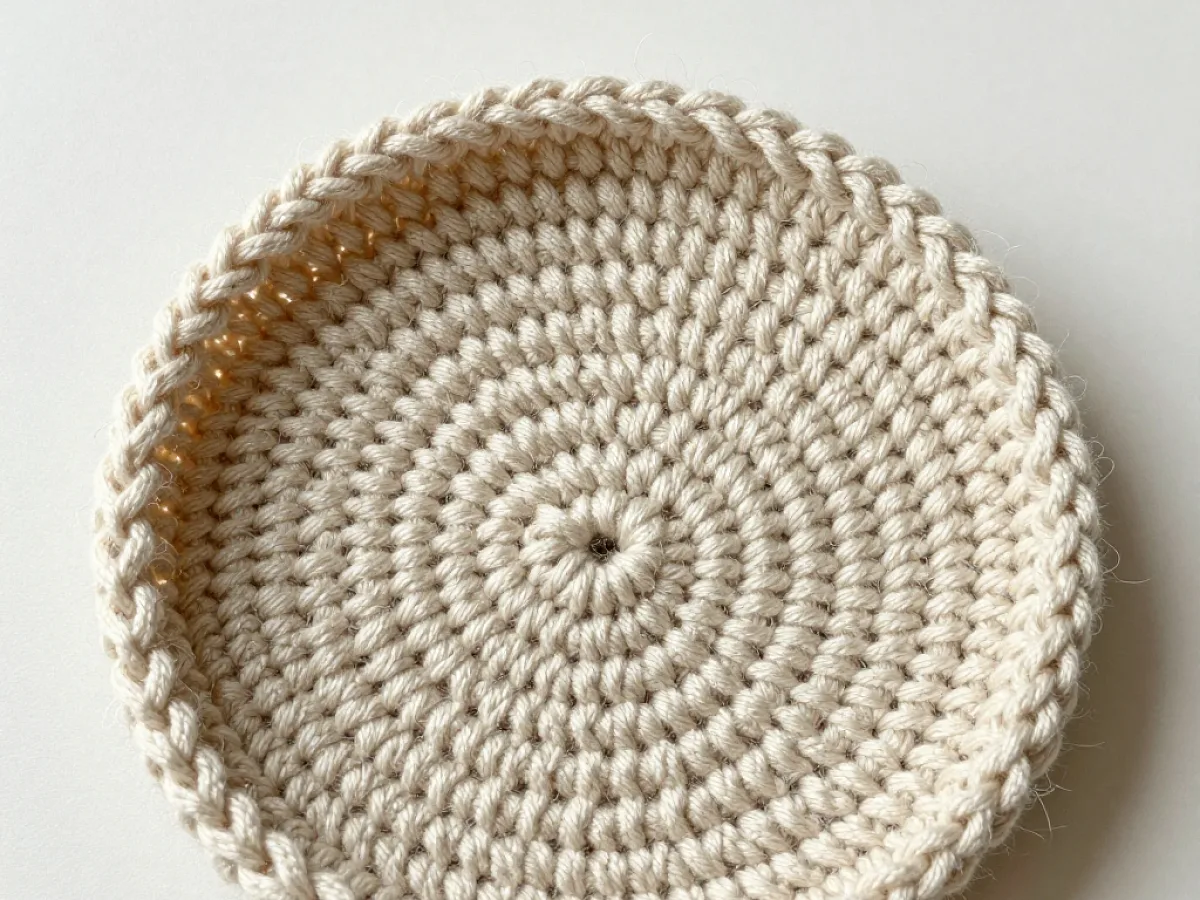
What you need
Worsted weight yarn
One 100 g ball in a light colour. Light yarn shows your stitches, dark yarn hides them.
5.0 mm crochet hook
Matches worsted yarn. A 5.5 mm or 4.5 mm hook also works and only changes the finished size.
Blunt yarn needle
For weaving in the tail. A sharp needle splits the yarn and leaves fuzzy ends.
Small scissors
Any pair will do. Keep them with your yarn so you stop losing them.
What you need before you start
Worsted weight yarn, often sold as size 4, is the easiest to learn on. It is thick enough to see your stitches and cheap enough that mistakes do not hurt.
A 5.0 mm hook matches worsted yarn. If you only have a 5.5 mm or 4.5 mm hook, use it anyway. The square will be slightly bigger or smaller and still work fine.
- Worsted weight yarn, one ball, about 100 g
- 5.0 mm crochet hook, aluminium or ergonomic handle
- Blunt yarn needle for weaving in the tail
- Small scissors
Avoid dark yarn and fuzzy yarn for your first square. Black hides your stitches, and mohair tangles into knots you cannot see.
How to hold the hook and yarn
Hold the hook like a knife, with your thumb and index finger near the flat grip. Some people hold it like a pencil instead. Both are correct, so pick whichever stops your hand from cramping after ten minutes.
Your yarn hand controls tension. Loop the yarn over your index finger and let it run to the hook. If the yarn feels tight, your stitches will be hard to pull through. If it feels loose, your stitches will look sloppy.
If your hand aches, you are gripping too hard. Put the work down for two minutes and shake your fingers out.
The slip knot and the starting chain
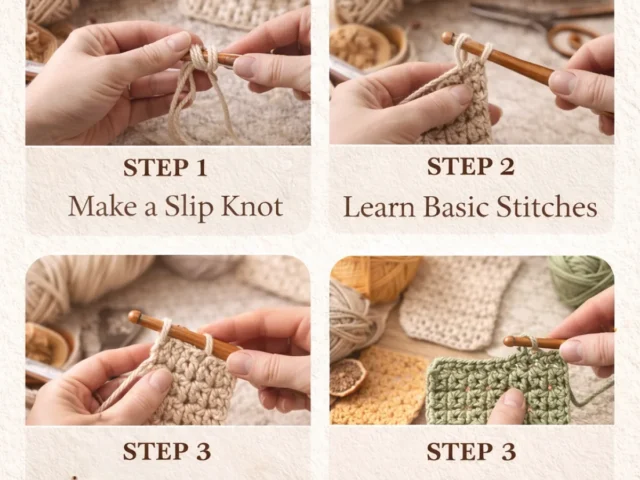
Make a loop, pull a second loop through it, and slide the knot onto the hook. Tighten it until it sits snug but can still slide along the hook. That is your slip knot.
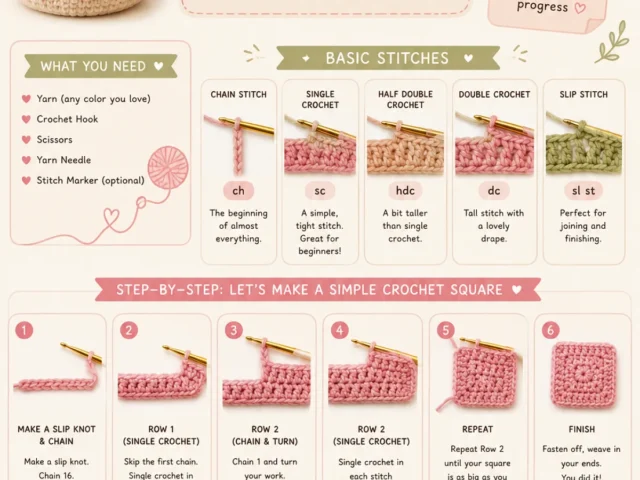
Now wrap the yarn over the hook and pull it through the loop. That is one chain. Do it 15 times. Your chain should look like a row of small V shapes facing you.
Count your chains out loud. A missed chain at this stage throws off the whole first row, and you will only notice three rows later.
Single crochet, the stitch you will use most
Insert the hook into the second chain from the hook. Wrap the yarn over, pull it through the chain, and you have two loops on the hook. Wrap again and pull through both loops. One single crochet made.
Work one single crochet into each chain across the row. At the end, chain one and turn the work like a page. That turning chain keeps your edges straight.
If your first row looks wider than your chain, you probably worked into the first chain instead of the second. Undo it and start the row again. It takes four minutes.
Common mistakes and how to spot them
Dropped stitches are the number one beginner problem. Lay your work flat and look at the top edge. If you see a gap the width of one stitch, you skipped one somewhere in the last row.
Too-tight tension shows up as a curled, stiff fabric that will not lie flat. Loosen your grip and try again with a hook one size bigger. Too-loose tension makes holes you can see through.
- Curling fabric: hook too small or yarn pulled too tight
- Wavy edges: you added a stitch at the end of a row
- Holes in the fabric: hook too big for the yarn
- Uneven rows: your turning chain was skipped or doubled
Count your stitches at the end of every row for the first five rows. After that, your eye will catch a mistake before your fingers do.
Finishing the square
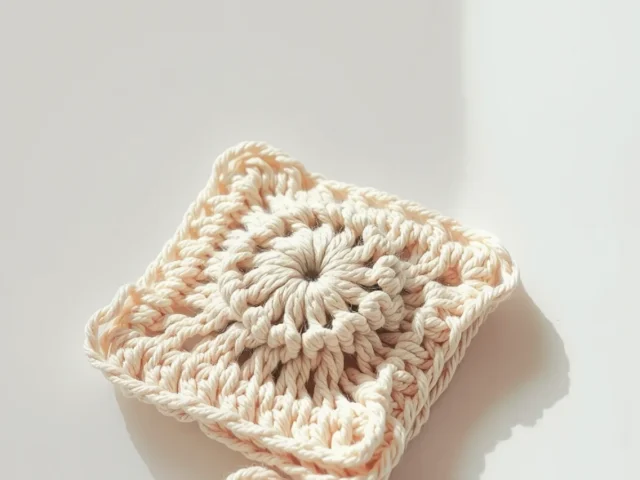
Work rows until the square measures about 10 cm on each side. For worsted yarn and a 5.0 mm hook, that is usually 12 to 14 rows of 14 stitches.
Cut the yarn, leaving a 15 cm tail. Pull the tail through the last loop and tighten. Thread the tail onto a blunt needle and weave it back through four or five stitches on the wrong side. Trim the rest.
Do not knot the ends. A knot works loose in the wash. Weaving through the stitches holds better and stays flat.
Step
Make the slip knot
Loop the yarn, pull a second loop through, and slide it onto the hook. It should slide along the hook but not fall off.
Chain 15
Wrap the yarn over the hook and pull it through the loop. Repeat until you have 15 chains. Count them out loud to be sure.
Work the first row
Insert the hook into the second chain from the hook, yarn over, pull through, yarn over, pull through both loops. Repeat into every chain across.
Turn and repeat
Chain one, turn the work, and single crochet into each stitch across. The chain one keeps your edge straight.
Work to 10 cm
Keep going until the square measures 10 cm on each side. Check with a ruler every few rows so you stop at the right size.
Finish and weave in
Cut a 15 cm tail, pull it through the last loop, and thread it through four or five stitches on the back. Trim the end.
Ways to change it
Cotton yarn instead of acrylic
Cotton has no stretch and shows stitch definition clearly. Good if you plan to make dishcloths next.
A bigger hook for a looser square
Try a 6.0 mm hook with the same yarn. The square grows faster and feels softer, but the stitches look less even.
Half double crochet
Same motion as single crochet but you pull through all three loops at once. Taller stitches, faster rows.
Two colours
Switch yarn at the end of a row for stripes. Change colour on the last pull-through of the final stitch to hide the join.
Make a coaster instead
Stop at 8 cm and you have a coaster. Same skills, ten fewer minutes.
The short version
- Worsted weight yarn and a 5.0 mm hook are the easiest pair to learn on.
- A 10 cm single crochet square takes about 45 minutes for a first-timer.
- The slip knot, chain, and single crochet are the only three moves you need today.
- Skipping a stitch shows up as a gap the width of one stitch in the top edge.
- Weave in the tail through four or five stitches instead of tying a knot.
- Count stitches at the end of every row for the first five rows.
Questions people ask
How long does it take to learn crochet?
You can make a flat square in about 45 minutes. Getting even tension takes a few sessions, usually two or three evenings of practice. Speed comes after that, not before.
What hook size should a beginner use?
A 5.0 mm hook with worsted weight yarn is the standard starting pair. If your stitches come out tight, move up to 5.5 mm. If they come out loose and holey, drop to 4.5 mm.
Why does my crochet curl up?
Curling usually means your tension is too tight or your hook is too small for the yarn. Try a hook one size bigger and let the yarn feed more freely over your finger.
Do I need to count stitches?
Yes, at least for the first five rows. Count at the end of each row. Once your eye learns what a straight edge looks like, you can count less often.
Can I crochet with just one hand?
Yes. Some crocheters hold the hook in one hand and tension the yarn with the same hand, holding the work steady against a table or their body. It is slower at first but works fine.
Grab your hook and make the first chain
Your first square will not be perfect, and that is fine. Make three of them and the fourth will look like someone taught you. Keep it quick and cute!