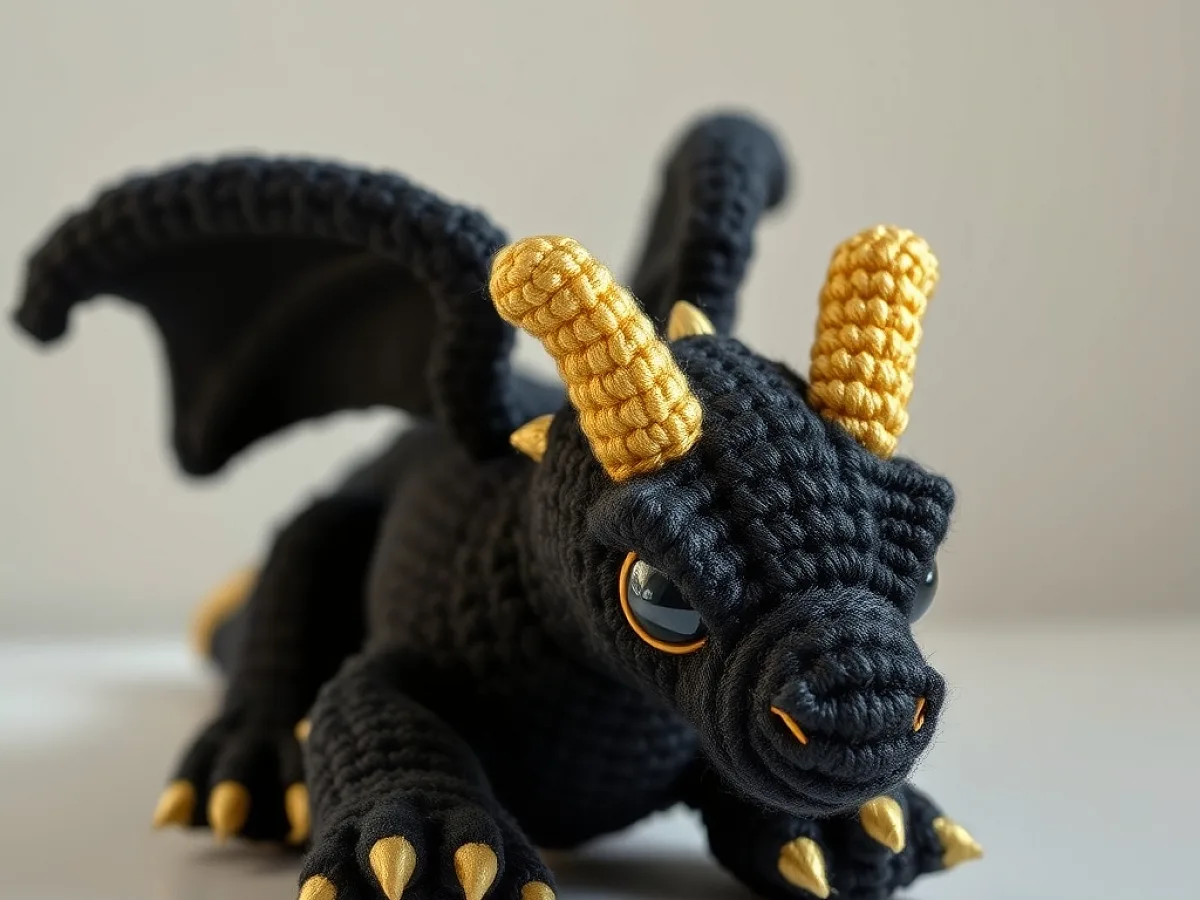
Giant Obsidian Black Dragon with Gold Horns Amigurumi
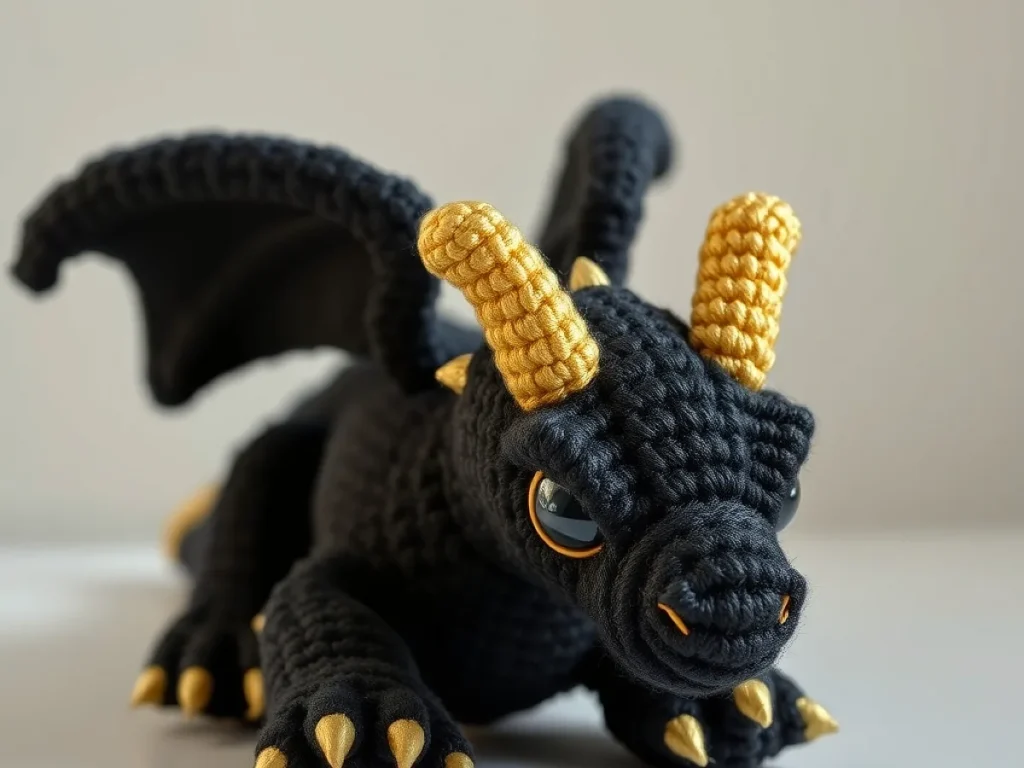
Work a black dragon roughly 60 cm long, with gold horns and wings that hold their shape.
Black yarn hides your stitches, so the horns on this dragon are the one place where a mistake shows from across the room.
Black yarn is the hardest colour to read while you work. The stitches blur together, the hook slips into the wrong loop, and you often only notice the gap three rounds later. That is the real challenge of this dragon, not the size.
The gold horns help. They give you a place to check your tension and your counting, because gold shows every stitch. Work the horns first if you want a warm-up before the body.
This is a large amigurumi dragon worked in single crochet, roughly 60 cm from nose to tail, in worsted black yarn with a 3.5 mm hook and gold accents on the horns and wing edges. You build it in pieces, stuff firmly, and join with mattress stitch so the seams disappear into the dark.
What you need
Worsted weight yarn in black
About 200 to 250 g. Acrylic is cheapest and holds shape well; cotton blend gives a firmer surface but is heavier.
Gold worsted yarn
One 50 g ball is plenty for horns and wing edges. A metallic chainette looks brighter in photos but splits more easily.
3.5 mm hook
Keep a 3 mm nearby for tight rounds. If your fabric shows light through it, go down a size.
Polyester fibrefill
Roughly 300 g. Add it in small handfuls, not one big lump, so the body stays smooth.
Safety eyes, 12 mm
Or embroider the eyes in black yarn if the dragon is for a young child.
Tapestry needle and stitch marker
A blunt needle with a large eye for joining. The marker goes in the first stitch of each round so you can count back.
Why black yarn makes this dragon harder than it looks
Worsted black yarn swallows shadows. Under a warm lamp the surface goes flat and the top of each single crochet stops reading as a separate loop. You end up counting by feel, running a fingertip along the round instead of trusting your eyes.
The fix is light, not patience. A daylight lamp or a bright white desk lamp aimed from the side throws a small shadow into every stitch. If you still cannot see, switch to a 4 mm hook for the first few rounds and go back to 3.5 mm once the shape is established.
Work near a window in the afternoon. Black yarn under yellow indoor light is where most counting errors start.
Yarn, hook and the numbers that matter
Use worsted weight acrylic or cotton blend in true black, about 200 g for the body and limbs. A 3.5 mm hook gives a tight fabric where the stuffing does not show through. If your stitches look loose enough to see light through them, drop to 3 mm rather than doubling the yarn.
Gauge is not fussy here, but it changes the finished size. Six single crochet to 2.5 cm means a dragon about 60 cm long. At five stitches to 2.5 cm you get closer to 70 cm, and you will need roughly 250 g of yarn instead.
- Worsted weight yarn, 200 to 250 g black
- Small amount of gold worsted for horns and wing edges
- 3.5 mm hook, plus a 3 mm spare for tight spots
- Polyester fibrefill, about 300 g
- Stitch marker, tapestry needle, scissors
- Two 12 mm safety eyes, or black yarn for embroidered eyes
If black worsted is out of stock, dark charcoal reads almost the same in photos and is far easier to see while you work.
Abbreviations and the stitches you will use
The pattern runs on five stitches. Nothing here is exotic, but the invisible decrease is worth practising on a scrap square first, because a standard decrease leaves a bump that shows on a black surface.
- ch: chain
- sc: single crochet
- sl st: slip stitch
- inc: two single crochet in the same stitch
- dec: invisible decrease, hook through front loops of two stitches
- BLO: back loop only
- FLO: front loop only
- ( ) x 6: repeat what is inside the brackets six times
The invisible decrease: insert the hook under the front loop of the next two stitches, yarn over, pull through both loops, yarn over, pull through the last two. It sits flat.
Order of construction
Build the horns first, then the head, then the body, then the limbs and wings. Horns are small and quick, and they let you check your gauge before you commit 200 g of yarn to a body that comes out the wrong size.
Stuff as you go. A dragon body stuffed at the end ends up lumpy at the neck and thin at the tail, because you cannot reach the middle to even it out.
What goes wrong, and how to tell
The most common problem is a visible stuffing shadow. Hold the body up to a lamp. If you can see pale grey patches through the black, your hook was too large or you stuffed too hard, and the fix is to line the inside with a scrap of black fabric before closing.
The second is a leaning head. That happens when the neck is sewn on before the body is fully stuffed. Undo the seam, add more fibrefill to the chest, and re-pin so the head sits level before you sew again.
If a seam gapes, do not pull harder. Unpick four stitches, re-sew with a smaller needle, and check that you are catching one loop from each side, not two from one.
Finishing, care and where it can live
Weave every tail in twice, in opposite directions, then trim. A single pass works loose after a few months of handling, and black yarn shows a popped tail as a small shiny loop.
Spot clean with cool water and a drop of mild soap, then pat dry and reshape by hand. Do not machine wash. The fibrefill clumps and the horns lose their curve. Keep the dragon out of direct sun, since black acrylic fades to a dull grey over a summer on a windowsill.
If the dragon sits on a shelf, brush the surface with a soft clothes brush every few weeks. Black yarn holds dust far more visibly than light colours.
Step
Work the two gold horns
Start with a magic ring of 4 sc in gold, increase to 12 over three rounds, then work 14 rounds straight and taper to 6. Stuff lightly and leave a 20 cm tail for sewing. The horn should hold its curve on its own before you move on.
Crochet the head
Begin with a magic ring of 6 sc in black, increase to 42 over seven rounds, work 12 rounds straight, then decrease back to 24. Place the eyes between rounds 14 and 15 with 8 stitches between them. If the muzzle looks flat, you have decreased too early.
Shape the body and neck
Chain 6, join, and increase to 48 around the widest point. Work 30 rounds straight for the chest, then decrease to 18 for the neck over six rounds. Stop when the neck is about 6 cm across, which is where the head joins.
Make four legs and two wings
Each leg starts at 6 sc, grows to 18, and runs 16 rounds before tapering to a 10 sc foot. Wings are worked flat in rows from the shoulder out, increasing at both ends every other row until 34 stitches wide, then decreasing back. Block the wings flat before sewing.
Join everything with mattress stitch
Pin the head, legs and wings in place first and look at the dragon from the side. Sew with mattress stitch using the yarn tails, catching one loop from each piece. Pull gently every three stitches so the seam sinks into the black instead of sitting on top.
Add the gold details last
Slip stitch a gold line along the top edge of each wing and around the base of each horn. Work this loosely. A tight gold line puckers the black fabric underneath and the pull shows along the whole wing.
Ways to change it
Smaller desk version
Use sport weight yarn and a 2.5 mm hook for a dragon about 30 cm long. Same pattern, roughly half the yarn.
Softer chenille black
Chenille gives a plush surface and hides seams well, but it sheds and the stitches vanish completely. Best for confident hands.
Embroidered eyes instead of safety eyes
Safer for a child under three. Work a small satin stitch oval in dark grey and add a tiny white highlight.
Deep purple instead of black
Keeps the dark dragon look but shows your stitch count far more clearly. Good for a first attempt.
Wire the wings
Thread a pipe cleaner through the wing edge before closing to hold a spread shape. Skip it if the dragon will be hugged.
The short version
- Black worsted yarn hides stitch definition, so work under daylight or a side lamp to count rounds accurately.
- A 3.5 mm hook with worsted yarn gives a fabric that does not show stuffing; if light passes through, go down to 3 mm.
- Gauge of 6 sc to 2.5 cm produces a dragon around 60 cm long and uses about 200 g of black yarn.
- Stuff the body as you go, in small handfuls, so the neck and tail stay even.
- Sew the head on only after the chest is fully stuffed, or the head will lean.
- Weave each tail in twice in opposite directions to stop ends working loose.
- Spot clean only. Machine washing clumps the fibrefill and flattens the horns.
Questions people ask
How much black yarn does a giant amigurumi dragon use?
About 200 g of worsted weight for a 60 cm dragon, and up to 250 g if your gauge is looser. Buy one extra ball, because dye lots vary and a mid-body join in black still shows in bright light.
Can I make this dragon in a lighter colour?
Yes, and it will be easier. Charcoal, deep purple and navy all keep the dark look while letting you see your stitches. The gold horns still read clearly against any of them.
How do I stop the stuffing showing through black stitches?
Hold the piece up to a lamp. If pale patches show, your hook is too large or the stuffing is packed too tightly. Go down one hook size and add fibrefill in smaller handfuls.
Are safety eyes safe for a young child?
Safety eyes can work loose with heavy pulling. For a child under three, embroider the eyes in yarn instead, or work a flat black oval with a small white highlight stitched on top.
How long does the whole dragon take?
Most people need 14 to 18 hours. The horns and head take about three hours, the body five, and the legs, wings and joining the rest.
Do I need to block the wings?
Yes, if you want them to lie flat. Pin them to a towel, mist with cool water, and leave them to dry overnight. Unblocked wings curl at the tips and the gold edge looks wavy.
Gather your black yarn and start with the horns
Work the gold horns first. They are small, quick, and they show you exactly how your tension behaves before you commit to the body. Stitch with ease.