Learn 8 Beginner Crochet Stitches: A Calm, Visual Guide
Work all eight stitches on one practice swatch, then read your own fabric to see which one you used.
A crochet swatch tells you which stitch made it before you count a single stitch, because each one sits at a different height.
Eight stitches cover almost every beginner pattern you will meet. Chain, slip stitch, single crochet, half double crochet, double crochet, treble crochet, increase, and magic ring. That is the whole list.
Each one sits at a different height, and that height is how you tell them apart later. Work them all on one practice swatch first. Then a pattern that says half double crochet will not slow you down.
Eight stitches cover almost every beginner pattern: chain, slip stitch, single crochet, half double crochet, double crochet, treble crochet, increase, and magic ring. Learn them on one worsted-weight swatch with a 5.5 mm hook and you can read the fabric as you go.
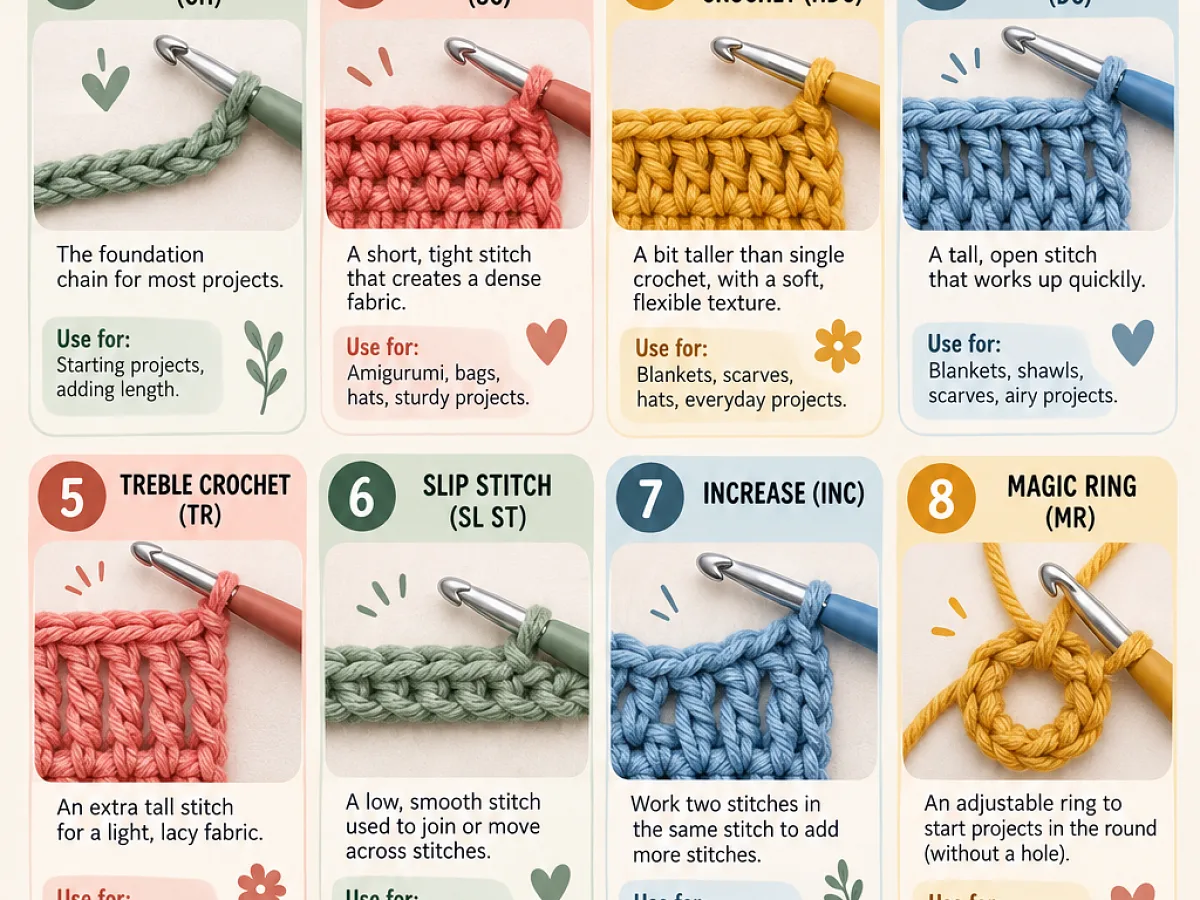
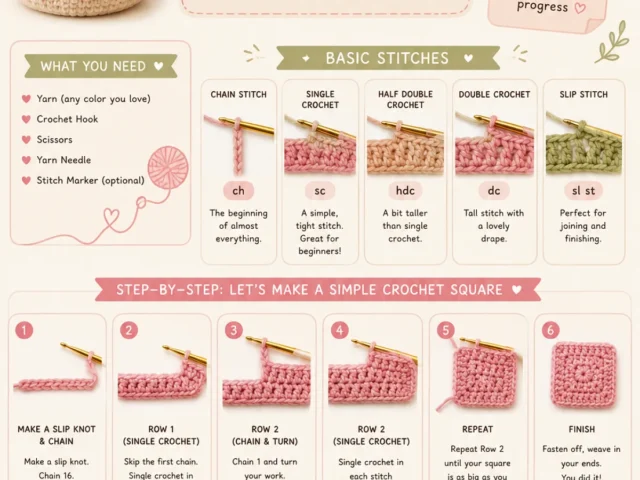
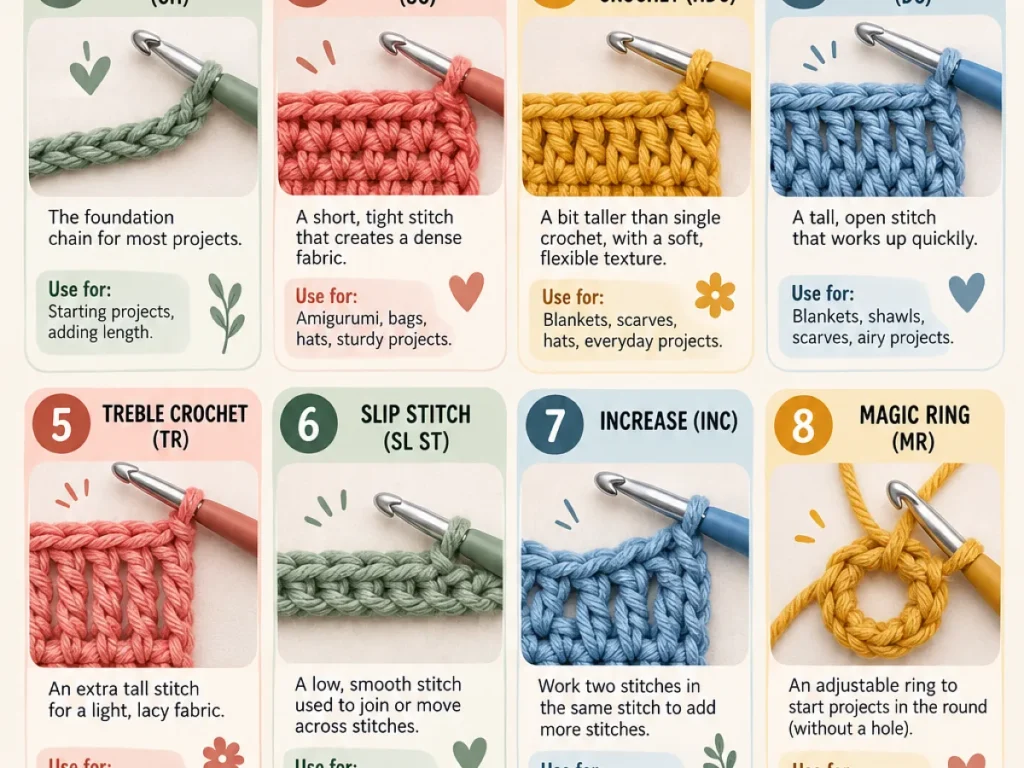
The eight stitches
Chain stitch
The starting point for almost every project.
Slip stitch
Joins rounds and travels across a row without adding height.
Single crochet
Short, firm fabric. Good for toys and dense edges.
Half double crochet
Medium height with a soft drape.
Double crochet
Tall and open. The usual choice for blankets and shawls.
Treble crochet
The tallest of the six. Good for lacy patterns.
Increase
Two stitches in one space. Makes circles and shapes grow.
Magic ring
A drawstring start for working in the round with no centre hole.
What you need
Worsted-weight yarn
Number 4 on the label. One 100 g ball is plenty. Light colours show stitch definition best.
5.5 mm hook
Sold as I-9 in the US. Go up to 6 mm if your tension runs tight, down to 5 mm if it runs loose.
Blunt tapestry needle
For weaving in ends. A sharp needle splits the yarn and leaves fuzzy spots.
Small scissors
Any pair works. Keep them with your project so you do not stop mid-row.
What you need before the first loop
Use worsted-weight yarn, the medium thickness sold as number 4 on the label. A light colour shows stitch definition better than black or navy, and smooth cotton or acrylic is easier to see into than fuzzy wool.
A 5.5 mm hook, labelled I-9 in the United States or 5.5 mm in the United Kingdom, matches worsted weight comfortably. If your loops feel tight and your hand aches, go up to 6 mm. If they slide off the hook, go down to 5 mm.
- Worsted-weight yarn, number 4 on the label
- 5.5 mm hook, or 6 mm if your tension runs tight
- Blunt tapestry needle for weaving in ends
- Small scissors
Gauge does not matter for a practice swatch. It matters the moment you make something that has to fit, like a hat or a mitten.
How to hold the yarn and hook
Hold the hook in your dominant hand the way you hold a pencil or a knife, whichever feels natural. Your other hand feeds the yarn and keeps light tension.
The working yarn runs over your index finger and under your middle finger. That finger is your tension control. If the yarn slides freely, wrap it once more around a finger.
Tension is the hardest part, not the stitches. If your first row looks uneven, that is normal and it evens out with practice.
The eight stitches, one at a time
Work each stitch into the chain or the row below, then look at what you made. The height is the giveaway. A slip stitch is almost flat. A treble crochet is taller than your fingertip.
- Chain (ch): yarn over, pull through the loop on your hook. The base of everything.
- Slip stitch (sl st): insert, yarn over, pull through both the stitch and the loop. Nearly no height.
- Single crochet (sc): insert, yarn over, pull up a loop, yarn over, pull through two. Short and firm.
- Half double crochet (hdc): yarn over first, insert, pull up a loop, yarn over, pull through all three. Medium height.
- Double crochet (dc): yarn over, insert, pull up a loop, yarn over through two, yarn over through two. Tall and open.
- Treble crochet (tr): yarn over twice, then work off two loops three times. The tallest of the six.
- Increase (inc): two stitches into the same stitch. This is how a flat circle grows.
- Magic ring: a loop you tighten closed, so a circle in the round has no hole in the middle.
Count your stitches at the end of every row for the first few rows. Most beginner problems are one stitch lost at a turn.
The order that actually works
Start with chain, because every other stitch begins from it. Then slip stitch, which teaches you where a stitch goes without adding height. Single crochet next, then half double, then double, then treble.
Increase and magic ring come last. Both are shapes rather than heights, and both make more sense once your basic tension is steady.
Make a chain of 20 and work one row of each stitch into a fresh chain. Eight short rows, one swatch, all eight stitches.
What goes wrong, and how to tell
The most common error is losing a stitch at the end of a row. You turn, forget the last stitch, and the row narrows. Count before you turn, not after.
The second is working into the wrong loop. You should go under both top loops of the V, not just the front one. If your fabric looks thin and stretched, check this first.
The third is a tight chain. If your starting chain curls and fights you, work it with a hook one size larger than the rest of the project, then switch back.
If a row is wrong, pull it out. Undoing is part of crochet, not a failure.
Finishing and joining
Cut the yarn about 15 cm from the last stitch, pull it through the final loop, and thread it onto a blunt tapestry needle. Weave it back and forth through the wrong side for about 5 cm, then trim.
To join a new colour, leave the old yarn attached until the new one is woven in. Two short tails are easier to hide than one long one.
Weave ends into a matching colour area, not across a colour change, or they show through.
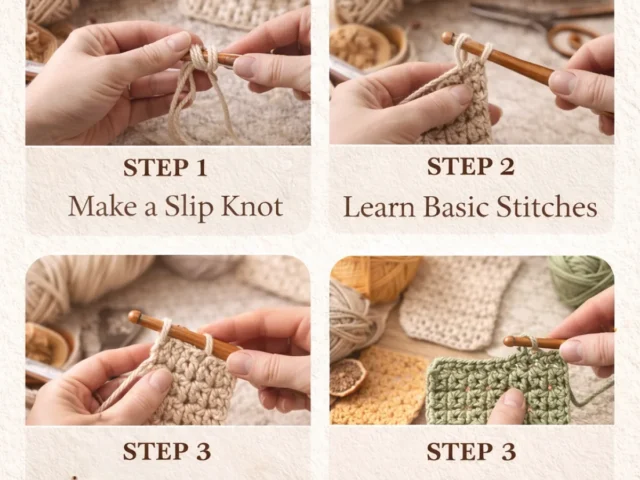
Step
Make a foundation chain
Chain 20. Count the V shapes, not the loops on the hook. The loop on your hook never counts as a stitch.
Work one row of single crochet
Insert under both top loops of the second chain from the hook. Pull up a loop, yarn over, pull through two. You should end with 19 stitches.
Add height
Work one row each of half double, double, and treble crochet into fresh chains. Lay the rows side by side and compare their heights.
Practise the increase
Work two single crochet into the same stitch. The fabric should fan outward, not stay straight.
Close a magic ring
Wrap the yarn twice around two fingers, work six single crochet into the loop, then pull the tail. The centre should close with no gap.
Weave in the ends
Thread each tail onto the tapestry needle and run it through the wrong side for about 5 cm before trimming.
Ways to change it
Cotton instead of acrylic
Less stretch and better stitch definition. Good for washcloths and bags.
A 6 mm hook
Looser fabric, easier for stiff hands and for learning new stitches.
Chunky yarn and an 8 mm hook
The stitches show up fast, which helps when you cannot yet read your work.
Two colours
Change colour at the end of a row to see how the stitches line up.
Work in the round
Use the magic ring and increase evenly to make a flat circle.
The short version
- Each stitch has a different height, and that height is how you identify it later.
- Worsted weight yarn with a 5.5 mm hook is the easiest combination for a first swatch.
- Counting stitches at the end of every row prevents most beginner mistakes.
- Most dropped stitches happen at the turn, not in the middle of a row.
- Gauge only matters when the finished piece has to fit a body or a shape.
- Increase and magic ring are shapes, not heights, so learn them after the six basic stitches.
Questions people ask
Which crochet stitch should a beginner learn first?
Start with the chain, then single crochet. The chain makes the base row, and single crochet teaches you where a stitch goes and how to keep an even tension.
How do I know which stitch I just made?
Look at the height. Slip stitch is nearly flat, single crochet is short and firm, half double sits in the middle, double crochet is tall and open, and treble crochet is the tallest.
Why does my crochet keep getting narrower?
You are almost certainly skipping the last stitch of the row. Count your stitches before you turn the work, and mark the first and last stitch with a removable marker.
What hook size should a beginner use?
A 5.5 mm hook with worsted-weight yarn, which is number 4 on the label. If your loops feel tight, move up to 6 mm.
Do I need a magic ring for a flat circle?
No, but it gives a cleaner centre with no hole. You can chain four and join into a ring instead, which is easier for a first attempt.
Pick up your hook and work one row of single crochet
Work the eight stitches once on a single swatch and you will recognise each one by height alone. Wash that swatch the way you plan to wash the finished piece, so you know how the yarn behaves before you commit to a whole blanket.