How to Make Easy Crochet (Beginner Friendly) Learn Easy Crochet
Learn the slip knot, chain and single crochet, then finish a small square you can keep.
A single crochet stitch takes about ten seconds once your hands know the motion, and most people get there in one sitting.
Crochet is one hook and one loop at a time. Nothing else is happening on the hook, which is why beginners pick it up faster than knitting.
This guide walks you through the first square. You will learn what to buy, how to hold everything, and how to spot the two mistakes that trip up almost every new crocheter.
Easy crochet starts with three things: a slip knot, a chain, and the single crochet stitch. With worsted yarn and a 5.0 mm hook you can make your first small square in about thirty minutes. Everything else you learn later is built on those three moves.
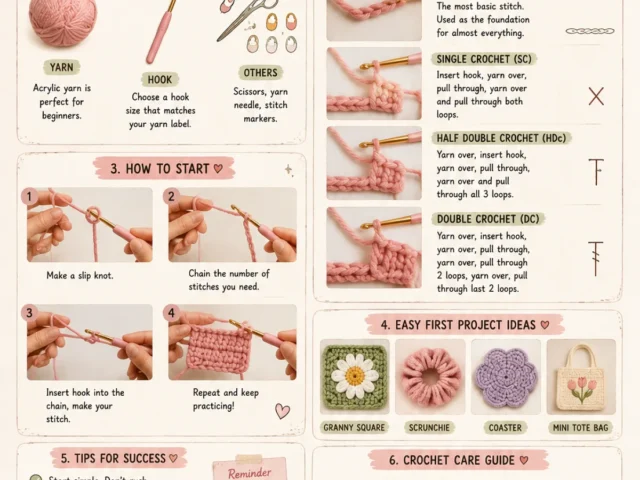
What you need
Worsted weight yarn, size 4
One 100 g ball is plenty for practice squares. Light colours like cream or pale grey show the stitches best.
Crochet hook, 5.0 mm (US H-8)
This is the standard match for worsted yarn. If your stitches feel tight, try a 5.5 mm instead.
Scissors
Any small pair works. Keep them with your yarn so you are not hunting for them mid-row.
Tapestry needle
A blunt needle with a large eye, used to weave in the loose ends when you finish.
Stitch marker
A safety pin or a scrap of contrasting yarn does the same job. It marks your first stitch so you do not lose it.
What you actually need to start
You need one hook, one ball of yarn, and a pair of scissors. That is the whole list. Buying more than that before your first square is a waste of money.
Pick a light-coloured yarn for your first project. Dark navy and black yarn hide the stitches, and you cannot see where the hook should go.
If your hands ache after ten minutes, your hook is probably too small for the yarn. Go up one size.
How to hold the hook and yarn
Hold the hook like a pencil or like a knife. Both work, and neither is wrong. Pick whichever lets your wrist stay relaxed.
The yarn runs over your index finger and under your pinky, with your thumb and middle finger pinching the work just below the hook. That pinch is what keeps your stitches even.
Tension comes from your fingers, not your wrist. If the yarn feels tight, let the strand slide a little more freely.
The three moves that make every stitch
Every crochet stitch is a variation of the same motion: put the hook in, wrap the yarn, pull it through, wrap again, pull through the loops on the hook.
Single crochet pulls through two loops. Double crochet pulls through two loops twice. Once you see that pattern, reading a pattern chart gets much easier.
Count your loops out loud for the first few rows. It slows you down and stops mistakes early.
Reading a pattern without panic
Crochet patterns use short forms. Ch means chain, sc means single crochet, dc means double crochet, sl st means slip stitch, and rep means repeat.
A pattern that says "ch 1, turn" at the end of a row is telling you to make one chain, then flip the work over so the next row goes the other direction. That chain keeps the edge from pulling in.
Write the stitch counts on a sticky note and cross them off as you finish each row.
Fixing the two mistakes beginners make
The first mistake is losing count. You add a stitch at the end of a row, or skip one, and the square turns into a triangle. Count every row before you turn.
The second is working into the wrong loop. The top of a stitch has two loops, and you go under both. Working under only the front loop leaves a ridge and makes the fabric looser than it should be.
If your edges look like stairs, your turning chain is probably too long. Try one chain fewer.
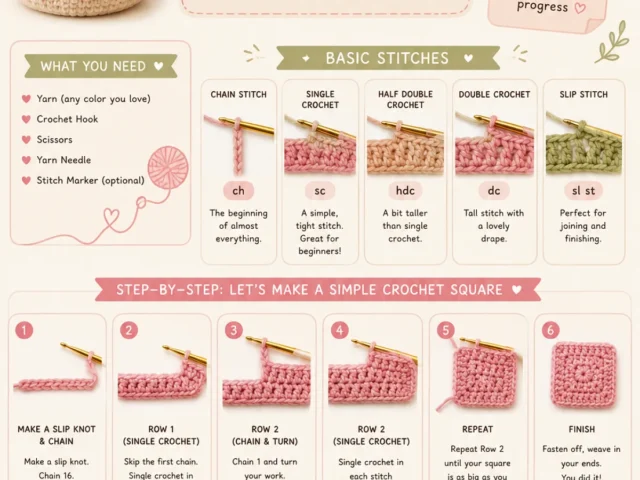
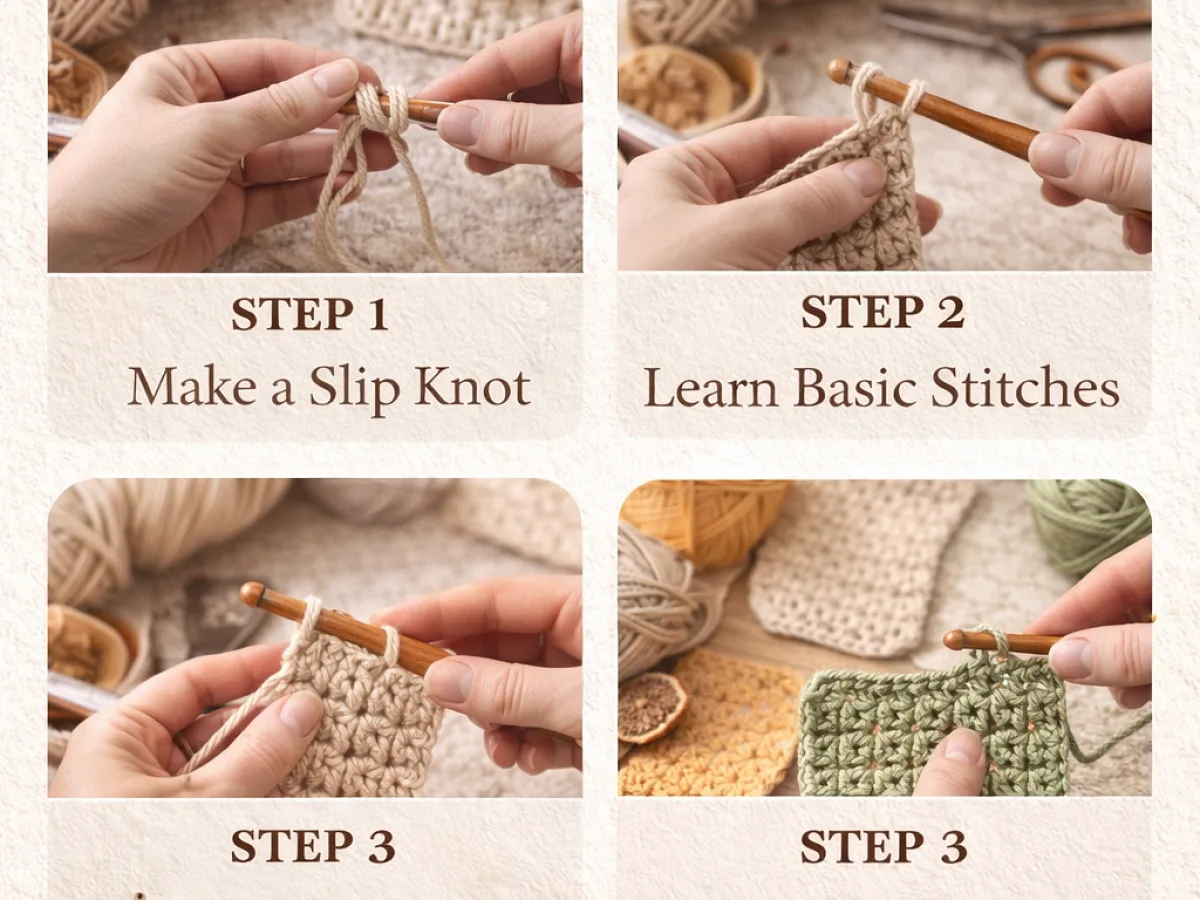
Step
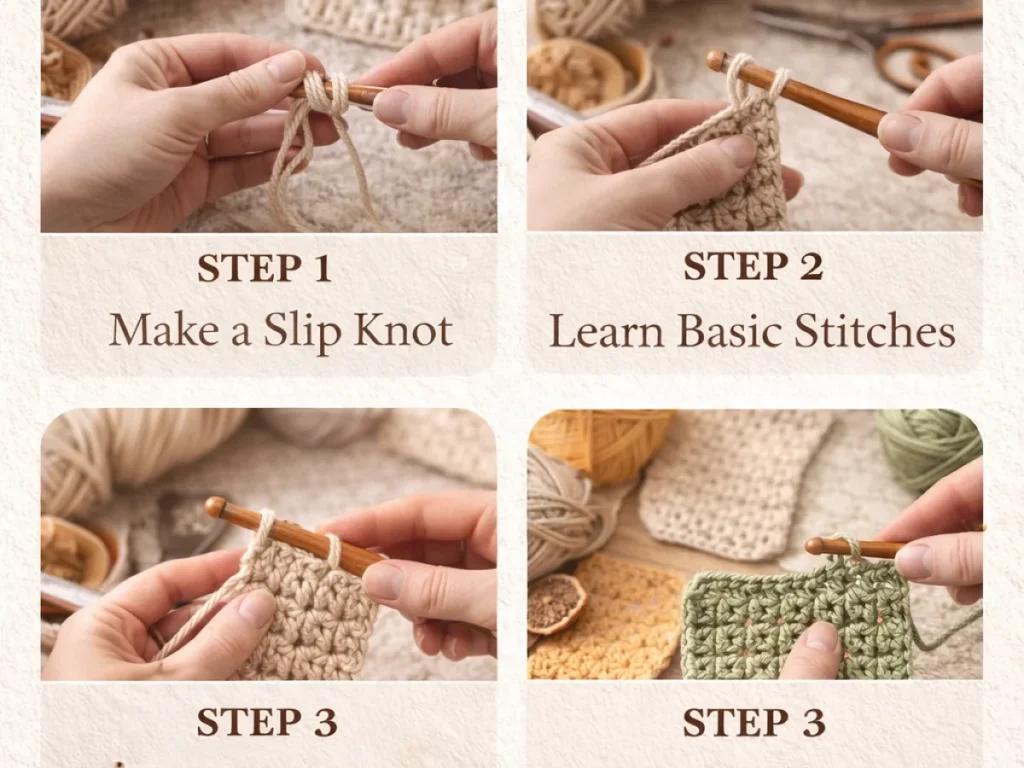
Make a slip knot
Loop the yarn over itself, pull the back strand through the loop, and slide the knot onto your hook. Pull the tail so the loop sits snug but still slides. If it will not move on the hook, it is too tight.
Chain 15
Wrap the yarn over the hook and pull it through the loop. That is one chain. Make fifteen, keeping each one the same size. Count them as you go, because chains are easy to lose track of.
Work the first single crochet
Skip the first chain, push the hook into the second chain from the hook, wrap the yarn, and pull up a loop. You now have two loops on the hook. Wrap again and pull through both. One single crochet made.
Continue across the row
Work one single crochet into every remaining chain. You should end with fourteen stitches. Count them before you turn, because this is where beginners drop one.
Turn and chain one
Chain one, then flip the work so the yarn is behind the hook again. That single chain is your turning chain, and it does not count as a stitch.
Work three more rows
Single crochet into the first stitch of the new row, and into every stitch after it. Keep going until you have four rows total. The square should look even, with straight sides.
Fasten off and weave in
Cut the yarn leaving a 15 cm tail, pull it through the last loop, and tighten. Thread the tail onto your tapestry needle and run it back and forth through the edge for about 5 cm.
Ways to change it
Use cotton instead of acrylic
Cotton has less stretch, so stitches look crisper. It is firmer on the hands and takes a bit more effort.
Try a thicker yarn
Super bulky yarn with a 8.0 mm hook makes a square twice as fast. Good if you want a quick finish.
Make a coaster
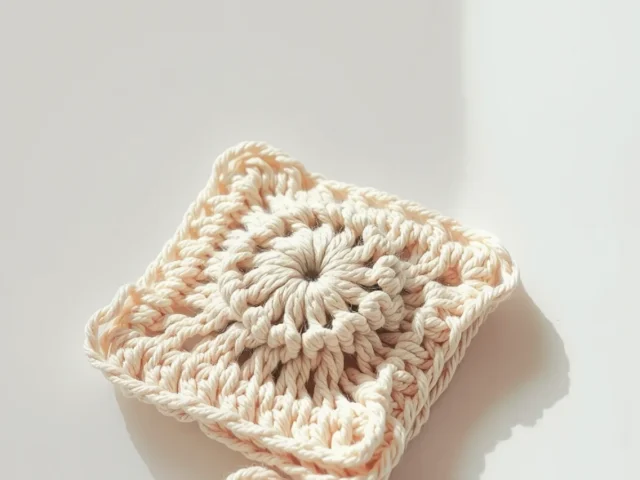
Stop at four rows and you have a small square that works as a coaster. Add a border of single crochet all the way around to tidy the edges.
Switch to half double crochet
Half double crochet is taller than single crochet and works up faster. It makes a slightly softer fabric.
Add a colour change
Finish a row with the old colour, then pull the new colour through the last loop. Change at the start of a row, never mid-row, for a clean edge.
The short version
- Worsted weight yarn with a 5.0 mm hook is the easiest combination for a first project.
- A slip knot, a chain and single crochet are the only three moves you need for a first square.
- Count your stitches at the end of every row, because one extra stitch turns a square into a triangle.
- Work under both top loops of a stitch, not just the front one.
- The turning chain at the end of a row keeps the edge straight.
- A 10 cm practice square takes about thirty minutes once you stop re-counting.
Questions people ask
What is the easiest crochet stitch for a total beginner?
Single crochet. It uses one loop at a time and gives a firm, even fabric. Learn it before anything else.
How do I stop my crochet edges from going wonky?
Count your stitches at the end of every row. Most wonky edges come from adding or losing one stitch at the turn.
How much yarn do I need for a first project?
One 100 g ball of worsted yarn is more than enough for several practice squares and a small coaster.
Why do my stitches look loose and gappy?
Your hook is probably too big for the yarn, or you are pulling the yarn too loosely. Try a smaller hook first.
Can I crochet left-handed?
Yes. Left-handed crocheters work in the opposite direction. Follow a video in a mirror or flip the image.
Pick up your hook and make that first square today
Make one square. Then make another. The second one will look better than the first, and the tenth will look like something you would actually use. Happy hooking!