Hungry Caterpillar Crochet Scarf Pattern: A Green Striped Scarf You Can Wear
Crochet a green striped caterpillar scarf in about four evenings using only hdc, sc, chain and slip stitch.
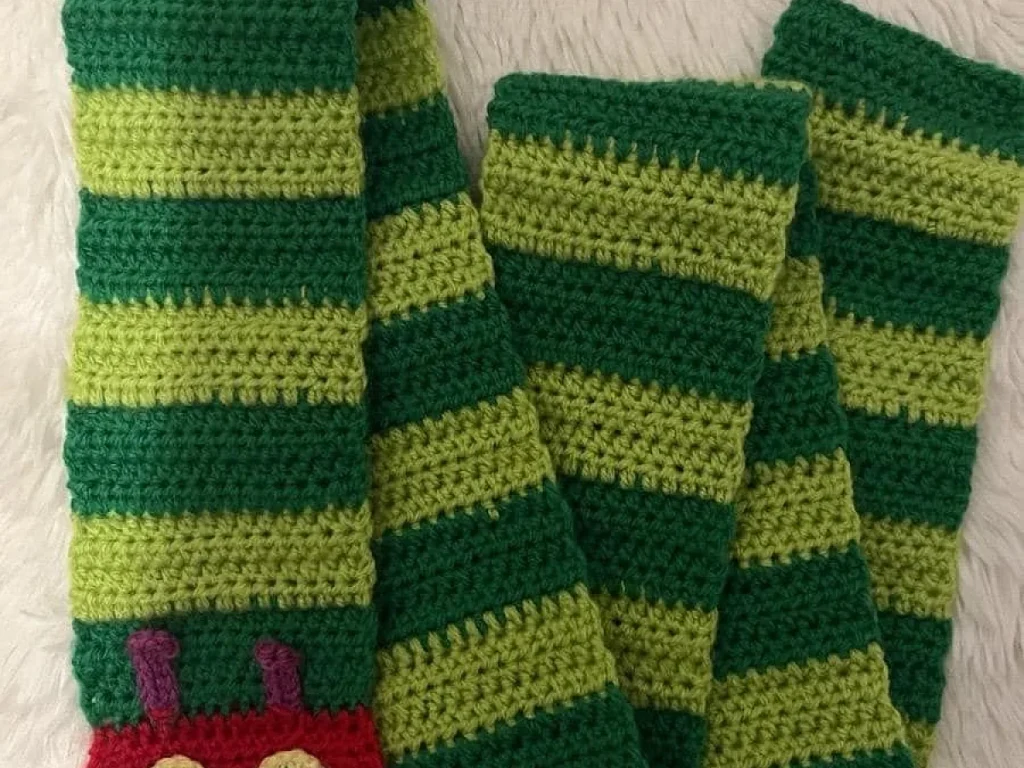
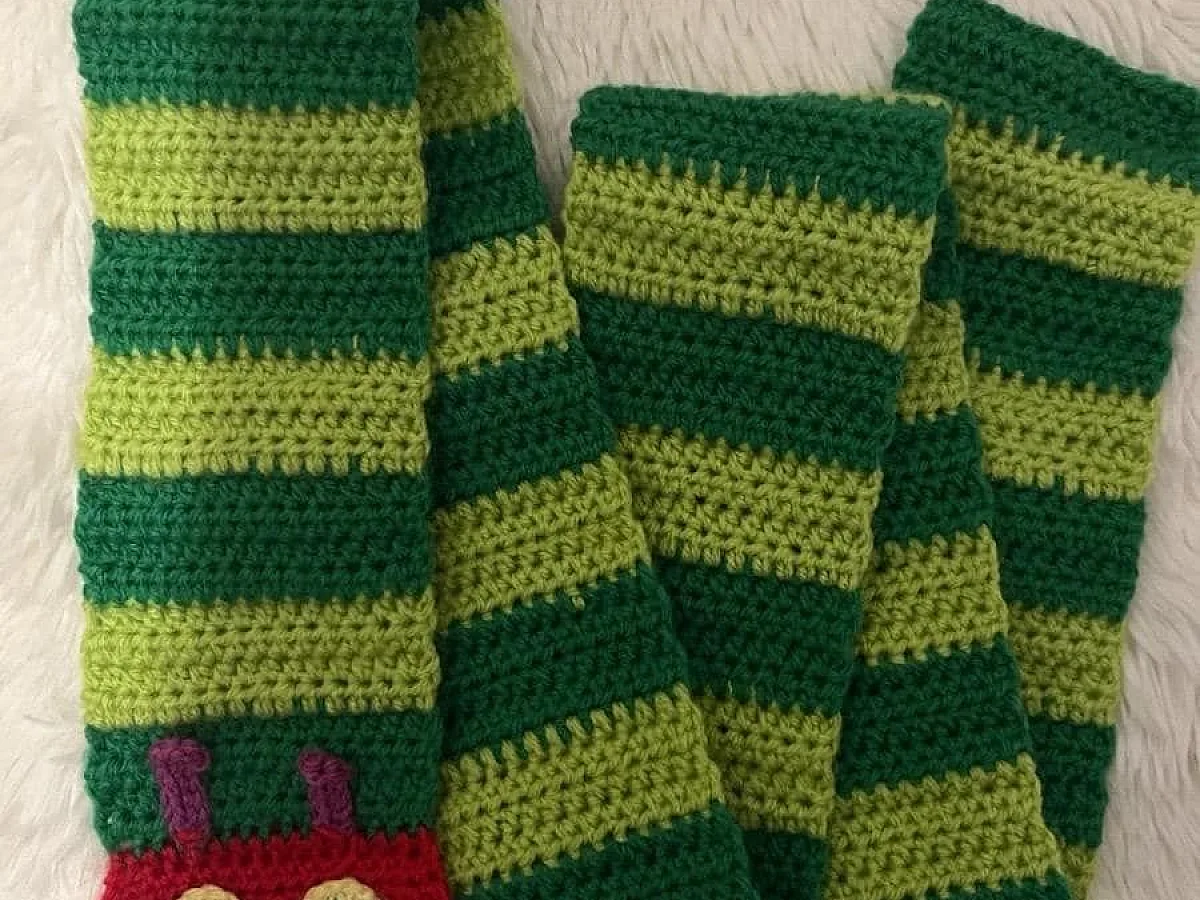
A caterpillar scarf is just a long rectangle of half double crochet with stripes, and the head is a circle sewn on at the end.
The whole scarf is one flat strip. No shaping, no turning corners, no counting to a hundred. If you can work a half double crochet row, you can finish this.
Plan on about four evenings for a worsted weight version, or roughly eight hours of crochet time. The stripes do most of the work, so you can keep your hands moving and your eyes on something else.
Work the body as a flat strip in half double crochet, changing color every four rows for the stripes. Then make a round head, add two chain antennae, and sew it to one end. It uses beginner stitches only: chain, slip stitch, single crochet, half double crochet, and half double crochet increase and decrease.
What you need
Worsted weight yarn, main green
One 200 gram ball covers an adult scarf. Acrylic is cheap and machine washable, cotton drapes heavier.
Worsted weight yarn, second green
About 50 grams for the stripes. A darker or lighter shade than the main green reads best.
Small amounts of black and white
Less than 10 grams each for the eyes. Scrap yarn is fine.
5.0 mm hook
Go up to 5.5 mm if your stitches are tight. The fabric should fold easily.
Blunt yarn needle
For sewing the head, eyes and antennae. A sharp needle splits the yarn.
Stitch marker
One is enough. Use it to mark the last stitch of each row.
What the scarf looks like and how big it gets
The body is a straight strip about 6 inches wide and 55 inches long for an adult. That length wraps once and hangs to about hip level on most people. For a child, stop at 40 inches.
The head is a flat circle roughly 6 inches across, worked in the same green as the body or in a darker green so it reads as a separate part. Two short chain antennae stick up from the top.
The stripes run across the width, not along the length. That means you change color at the end of a row, not mid-row, which keeps the edges clean.
Measure the strip on a flat table, not while it hangs. A hanging scarf stretches and you will stop too short.
Yarn, hook and the numbers that matter
Worsted weight yarn in two greens, plus a small amount of black and white for the face. One 200 gram ball of the main green is enough for an adult scarf with yarn left over.
A 5.0 mm hook gives a soft, drapey fabric. If your stitches pull tight, go up to 5.5 mm. Gauge is not critical here, but the strip should feel loose enough to fold, not stiff.
Stitch counts are simple. Start with 20 half double crochet across, and keep 20 in every row until you reach your length.
Abbreviations used in this pattern
These are US terms. If you learned UK terms, your half double crochet is called half treble there, so read the whole pattern in one system and stay in it.
- ch – chain
- sl st – slip stitch
- sc – single crochet
- hdc – half double crochet
- hdc inc – two hdc in the same stitch
- hdc dec – half double crochet two stitches together
- st – stitch
- FO – fasten off
Making the striped body
Work the body first, because everything else is sized to match it. Change color every four rows for bold stripes, or every two rows if you want a finer look.
The head, the face and the antennae
The head is a flat circle worked in the round, starting with a magic ring or a chain 4 joined into a loop. Six rounds gets you to about 6 inches across with worsted weight.
Increase six times per round for the first four rounds, then work one round even. That gives a flat circle. If the edges start to ruffle, you have too many increases. If it cups upward, you need more.
Sew the head to one end of the strip with the same green yarn and a blunt needle. Go around twice so it does not flop forward when you wear it.
Pin the head in place before sewing. Once it is stitched, pulling it off leaves holes in the scarf.
Eyes and antennae
Two small white circles with a black center make the eyes. Single crochet six into a magic ring, then slip stitch to close. Sew them on about 1 inch apart, sitting slightly above the middle of the head.
For the antennae, chain 8, then slip stitch back down the chain. Make two and sew them to the top of the head, about 2 inches apart.
If you would rather not crochet tiny eyes, felt circles or safety eyes work just as well. Safety eyes need a washer pushed on from the back, so add them before you stuff or sew anything closed.
Where beginners go wrong
The most common problem is a scarf that gets wider as it goes. That happens when you work an extra stitch into the turning chain. Count your 20 stitches at the end of every row for the first ten rows, then you can relax.
The second problem is a stiff, board-like scarf. That comes from a hook that is too small or from pulling each stitch tight. Try one size up before you rip anything out.
The third is stripes that jog. If you change color in the middle of a row instead of at the end, the stripe will step sideways. Always finish the row first.
If you lose your place, clip a stitch marker into the last stitch of the row you just finished. It takes two seconds and saves ten minutes of counting.
Step
Make the body strip
Chain 22, work 20 hdc across, and repeat rows until the strip is 55 inches long. Change color every four rows for stripes.
Work the head circle
Start with a magic ring, increase six times per round for four rounds, then work one round even. You should have a flat circle about 6 inches across.
Add the eyes
Crochet two small white circles with black centers, or use felt or safety eyes. Place them about 1 inch apart on the head.
Make the antennae
Chain 8 and slip stitch back down each chain. Make two and set them aside.
Join everything
Sew the head to one end of the strip, then sew the antennae to the top of the head. Weave in all ends and check that nothing pulls loose.
Ways to change it
Bookmark version
Work the body only 30 inches long and add a tassel at the plain end. Good for a child who trips on long scarves.
Chunky yarn version
Use super bulky yarn and an 8.0 mm hook. The scarf finishes in about three hours but gets heavy around the neck.
Finger puppet head
Leave a small opening at the back of the head and slide a finger in. Turns the scarf into a toy between wears.
Color swap
Use blue or purple stripes instead of green. The shape still reads as a caterpillar, just a less obvious one.
No-sew version
Work the head directly onto the end of the strip by picking up stitches along the edge. Saves the sewing but takes more counting.
The short version
- The body is a flat 20-stitch strip in half double crochet, 55 inches long for adults.
- Change color at the end of a row, never mid-row, or the stripes will jog sideways.
- A flat head circle needs six increases per round for four rounds, then one even round.
- Count your stitches for the first ten rows to stop the scarf widening.
- Gauge is not critical, but a tight stitch makes a stiff scarf, so go up a hook size.
- Safety eyes must be attached before the head is sewn on.
Questions people ask
Can a total beginner crochet this scarf?
Yes, if you already know chain, slip stitch, single crochet and half double crochet. The body is one repeated row with no shaping. The head is the only part that needs counting.
How much yarn does a caterpillar scarf take?
About 200 grams of worsted weight for the main color and 50 grams for the stripes on an adult size. A child size uses roughly half that.
How long should the scarf be?
55 inches for an adult, 40 inches for a child, and about 30 inches if you want a short scarf that tucks into a coat. Measure it flat on a table.
Do I have to sew the head on?
No. You can pick up stitches along the end of the strip and work the head directly onto it. It saves the sewing but makes the stitch count harder to track.
What if my circle turns into a bowl?
That means you need more increases. Add one extra increase round, or space your six increases further apart, and the circle will flatten out.
Grab your green yarn and start the first stripe tonight
The scarf is one strip, one circle and two antennae. Work the body first, check the length flat, and the rest falls into place. Keep it quick and cute!