Learn the Crochet Basic Stitches for Beginners: 8 Stitches Step by Step
By the end you will work a chain, a single crochet, and a double crochet, and know how to count your stitches.
Eight stitches cover almost everything you will crochet for the next year.
Every blanket, hat, and amigurumi toy is built from the same handful of moves. Learn eight of them and you can read most beginner patterns without guessing.
This guide goes in the order your hands need. Each stitch builds on the one before it, so nothing feels like a jump. Take them one at a time and give each one ten minutes of practice before you move on.
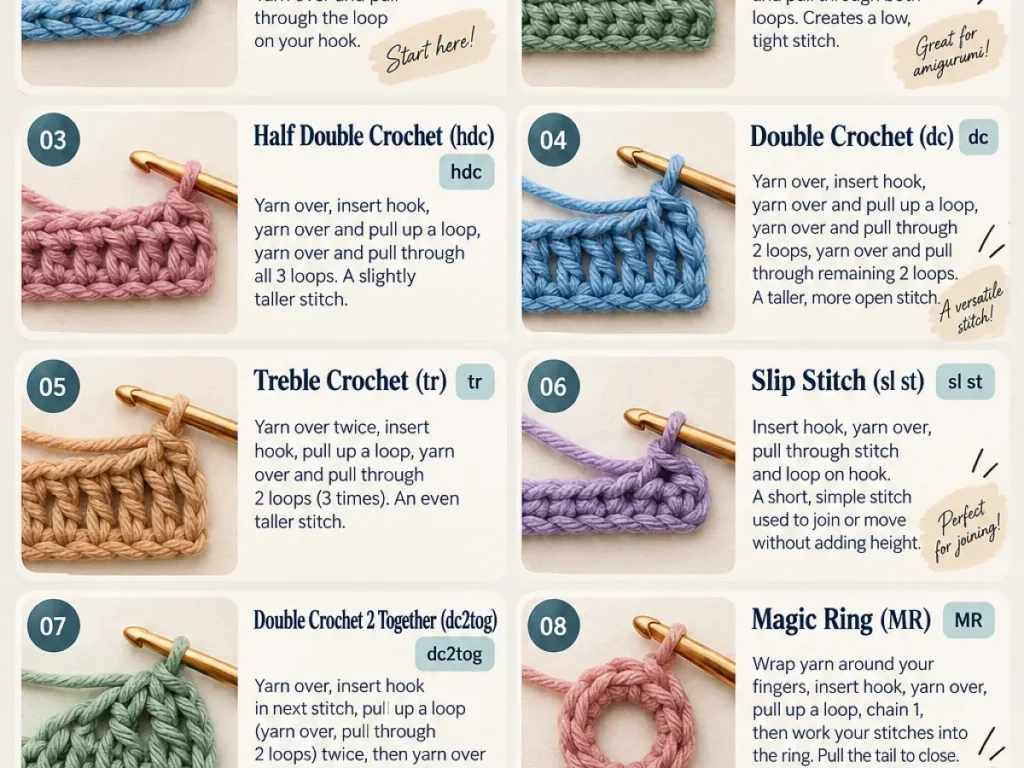
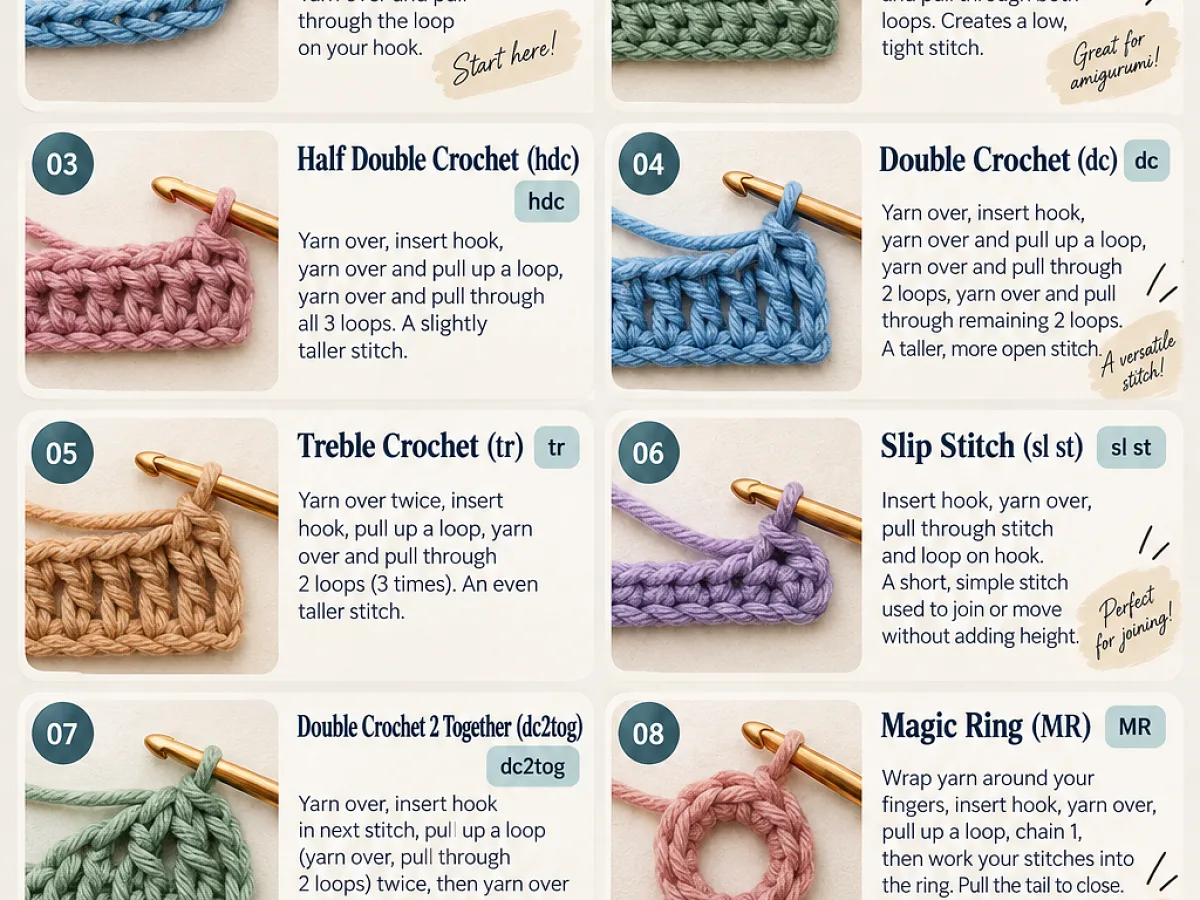
There are eight basic crochet stitches worth learning first: chain, slip stitch, single crochet, half double crochet, double crochet, treble crochet, decrease, and the magic ring. Start with a worsted weight yarn and a 5 mm hook, learn the chain and single crochet, then add the taller stitches one at a time.
The eight stitches
Chain (ch)
The foundation row and the base for taller stitches.
Slip stitch (sl st)
Joins rounds and moves across the fabric with almost no height.
Single crochet (sc)
Short, firm, and dense. The standard stitch for toys and washcloths.
Half double crochet (hdc)
Medium height with a soft drape. Quick to work and good for scarves.
Double crochet (dc)
Tall and quick. The stitch behind most blankets and granny squares.
Treble crochet (tr)
The tallest basic stitch. Open and lacy, good for shawls.
Decrease (sc2tog)
Turns two stitches into one. Used for shaping hats and toys.
Magic ring
A closable circle start for amigurumi and any round project.
What you need
Worsted weight yarn
Look for number 4 or medium on the label. One 100 g ball is plenty for practice and a small project. Light colors show your stitches best.
Crochet hook, 5 mm
Usually marked H-8 in US sizes. Buy one with a soft grip if you can, since you will hold it for long stretches.
Blunt yarn needle
For weaving in ends. A metal one with a large eye slides through stitches without splitting the yarn.
Small scissors
Any sharp pair works. Keep them close so you are not hunting for them mid-row.
Stitch markers
Plastic clips or even a bent paperclip. They mark the first stitch of a row so you do not lose your place.
What you need before your first stitch
You do not need much. A light-colored yarn shows your stitches clearly, which matters more than you think when you are learning to see where the hook goes. Dark yarn hides every mistake, including the ones you want to catch.
Work with worsted weight yarn, often sold as medium weight or number 4 on the label, and a 5 mm hook. That pairing is forgiving. If your stitches come out tight and hard to push the hook into, go up to a 5.5 mm hook rather than fighting the yarn.
If you are left-handed, hold the hook in your left hand and mirror every step. The stitches are identical, only the direction flips.
How to hold the hook and yarn
Hold the hook like a knife, with your thumb and index finger near the flat grip. Some people hold it like a pencil instead. Both work, so pick whichever keeps your wrist relaxed.
The yarn runs from the ball, over your index finger, and under your middle finger. Your index finger controls the tension. If the yarn slips loose, wrap it once more around your little finger.
Tension is the whole game. If your chain feels loose and loopy, the yarn is not held firmly enough.
The eight basic stitches in order
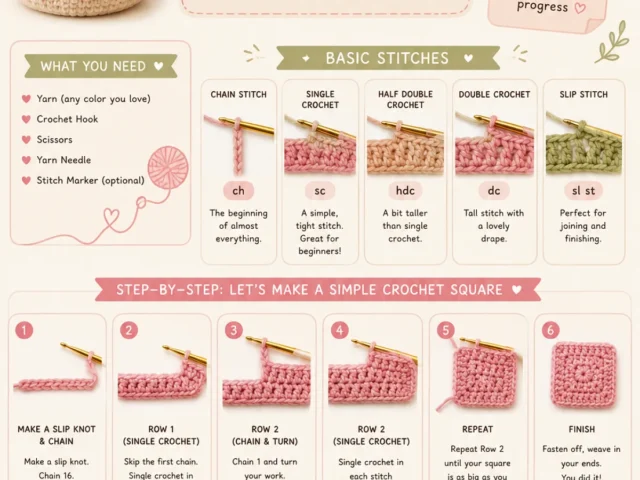
Learn them in this order and each one makes sense. The chain is the foundation. The slip stitch joins and travels. The single crochet is your first real fabric. The taller stitches follow the same motion, just with more wraps on the hook.
The decrease and the magic ring are shaping tools. You will use the decrease for hats and toys, and the magic ring for anything worked in a circle.
- Chain (ch): the starting row and the base of everything
- Slip stitch (sl st): joins rounds and moves across without height
- Single crochet (sc): short, firm fabric for toys and washcloths
- Half double crochet (hdc): medium height, soft and quick
- Double crochet (dc): the workhorse for blankets and granny squares
- Treble crochet (tr): tall, open, lacy fabric
- Decrease (sc2tog): turns two stitches into one
- Magic ring (magic circle): a tight, closable start for circles
Write the abbreviations on a sticky note and keep it beside you. Patterns use them constantly.
Step by step: your first chain and single crochet
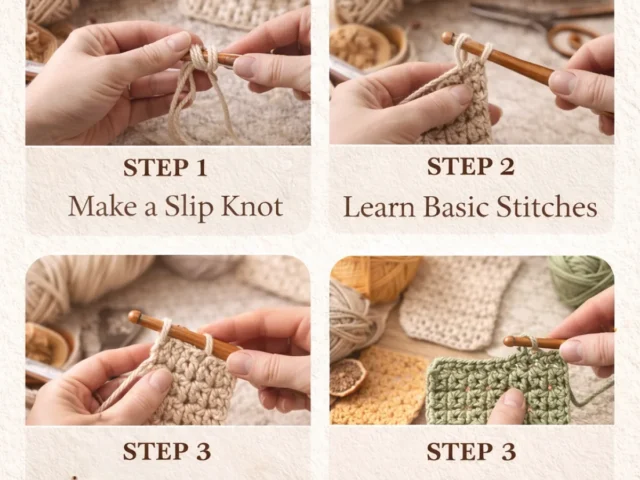
Make a slip knot, slide it on the hook, and tighten it so it sits snug but can still slide. Then work the steps below. Check your work after each one before moving on.
Count your chain twice. A chain that is one stitch short will throw off the whole first row.
Common mistakes and how to fix them
The most common beginner error is losing stitches at the end of a row. You work the last stitch into the turning chain by mistake, or you skip it entirely. Count your stitches at the end of every row for the first few rows. If the number keeps shrinking, you are skipping the first stitch. If it keeps growing, you are adding one at the end.
Another frequent problem is working into only one loop of the chain. You should see two loops, a V shape, on the front of the chain. Slide the hook under both loops unless the pattern tells you otherwise.
If your fabric curls into a tube, your tension is too tight. Go up one hook size and try again.
Lay your work flat on a table every few rows. Curling and shrinking are much easier to spot from above than in your hands.
How to finish and join your work
To fasten off, cut the yarn leaving a tail about 15 cm long. Pull the tail through the last loop and tug gently. That knot holds.
To join a new color or a new ball, work until the last stitch of the row, then finish that stitch with the new yarn. Weave both tails in later with a blunt yarn needle, going back and forth through the stitches for about 5 cm.
Never knot two yarn ends together in the middle of your fabric. The knot works loose and shows through.
Test your work
Before you call a swatch finished, do this quick check. Lay it flat and count the stitches across one row. Then count the rows. If your count matches the pattern and the edges look straight, you are ready to start a real project.
If the edges lean in or out like a trapezoid, your stitch count drifted. Pull the row out and work it again with the same count. It takes two minutes and saves an hour later.
A 15 cm by 15 cm swatch is enough to see your tension clearly. Make one before every new project.
Step
Make a slip knot
Loop the yarn over itself, pull the working end through the loop, and slide the knot onto your hook. Tighten it until it sits snug against the hook but still slides. If it will not move, it is too tight.
Chain 10 stitches
Wrap the yarn over the hook from back to front, then pull it through the loop on your hook. That is one chain. Repeat until you have 10. Count the V shapes on the front, not the loops on the back.
Work into the second chain from the hook
Skip the loop on your hook and the first chain. Insert the hook under both loops of the next chain. You should see the V open up as the hook goes in.
Pull up a loop
Wrap the yarn over the hook and pull it back through the chain. You now have two loops on the hook. Do not let them twist.
Close the single crochet
Wrap the yarn over the hook again and pull it through both loops at once. One loop remains. That is your first single crochet. Work one into each remaining chain across.
Chain one and turn
Chain one stitch, then flip your work over like a page in a book. The chain you just made is the turning chain. It gives the next row its height without adding a stitch.
Work row two
Skip the turning chain and work a single crochet into the first real stitch. Work one stitch into each stitch across. At the end, count your stitches. You should have 10, the same as row one.
Ways to change it
Thicker yarn and a bigger hook
Chunky yarn with an 8 mm hook makes stitches easy to see. Good if your hands feel clumsy at first.
Cotton instead of wool
Cotton shows stitch definition clearly and does not stretch. Good for washcloths and potholders.
Practice a flat swatch
Work rows of single crochet until the square is 15 cm. The most useful first project there is.
Start a granny square
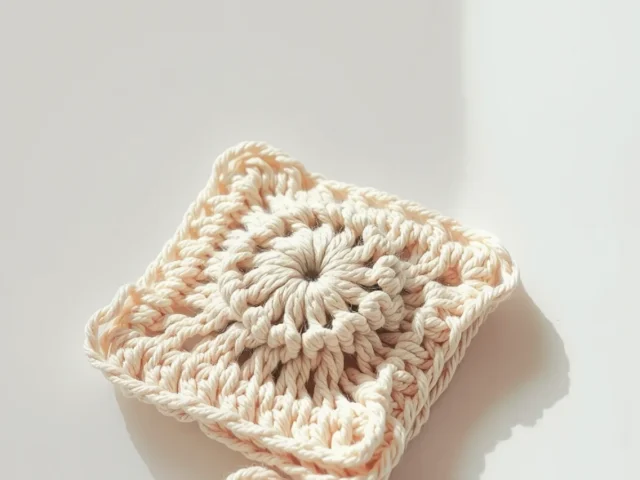
Uses chain, double crochet, and slip stitch in one small project. A good next step after this guide.
Try a cotton washcloth
About 20 cm square, worked in single crochet. Finished in an evening and useful straight away.
The short version
- Eight stitches cover nearly every beginner pattern you will meet.
- Worsted weight yarn with a 5 mm hook is the easiest pairing to learn on.
- Count your stitches at the end of every row for the first few rows.
- Work under both loops of the chain unless the pattern says otherwise.
- Losing or adding a stitch at the row end is the most common beginner mistake.
- A 15 cm swatch tells you whether your tension matches the pattern.
- Finish with a 15 cm tail and weave it in with a blunt needle, never a knot.
Questions people ask
How long does it take to learn the basic crochet stitches?
Most people can chain and work single crochet within about 30 minutes. The taller stitches take another practice session each. Give yourself a few evenings before the motions feel automatic.
What is the easiest crochet stitch for a total beginner?
Single crochet. It is short, firm, and easy to see where the hook goes. Once that feels steady, half double and double crochet are simple additions.
Why does my crochet keep getting wider or narrower?
You are adding or losing a stitch at the end of the row. Count every row until the number stays the same. Mark the first stitch with a clip so you know exactly where the row ends.
Do I need special yarn to learn crochet?
No. Any worsted weight yarn works. Pick a light color, since dark yarn hides the stitch loops you need to see.
What hook size should a beginner use?
A 5 mm hook, sold as US size H-8, with worsted weight yarn. If your stitches feel tight and hard to work into, move up to 5.5 mm.
How do I stop my crochet from curling?
Curling usually means your tension is tight. Go up one hook size and check that your starting chain is not tighter than your rows.
Grab your hook and work one row of single crochet tonight
Pick up your yarn, make a slip knot, and chain ten. That is the whole first lesson. Everything else in crochet is a small change to what your hands already know. Happy hooking!