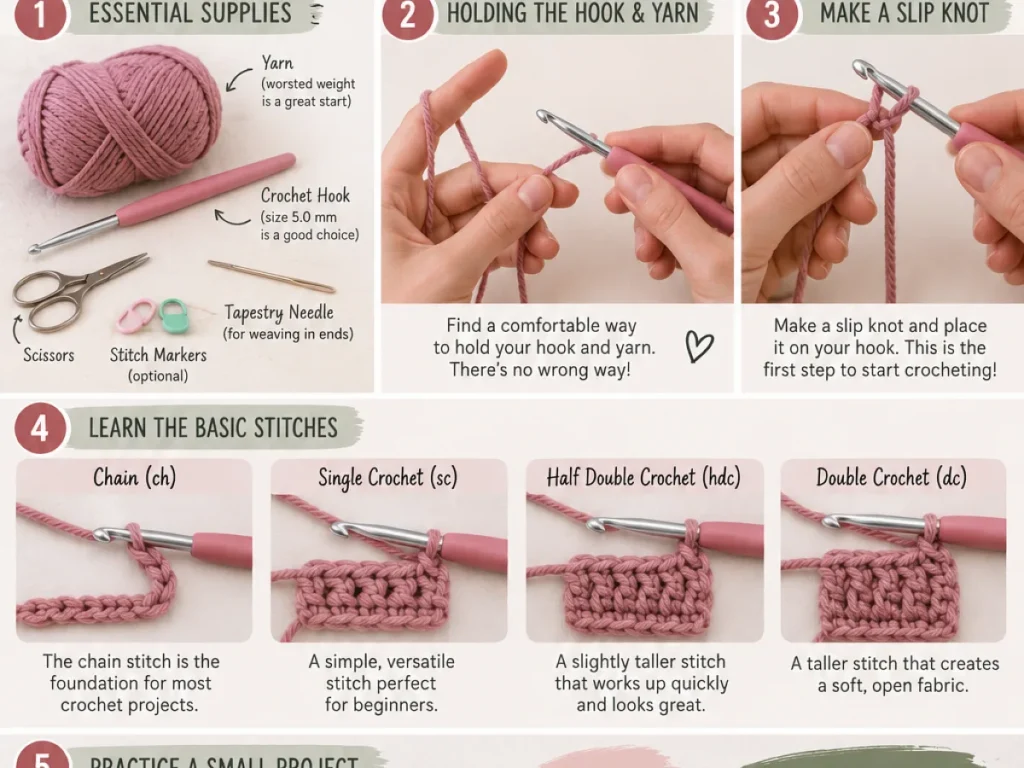
Learn How to Crochet for Absolute Beginners
By the end you will hold the yarn, make a slip knot, and work chain, single crochet, half double crochet and double crochet stitches.
A crochet hook costs about three dollars and one ball of worsted yarn is enough to learn every basic stitch.
Crochet is one loop pulled through another. That is the whole craft. Everything else is a small change in where you put the hook and how many times you wrap the yarn.
You can learn the four basic stitches in one sitting. Your first rows will look uneven, and that is normal. The evenness comes from your hands, not from a better hook.
You only need three things to start: a hook, a ball of yarn and about twenty minutes. Begin with a slip knot, work a chain, then practice single crochet until your edges look even. The other basic stitches follow the same hand movements with one extra step each.
What you need
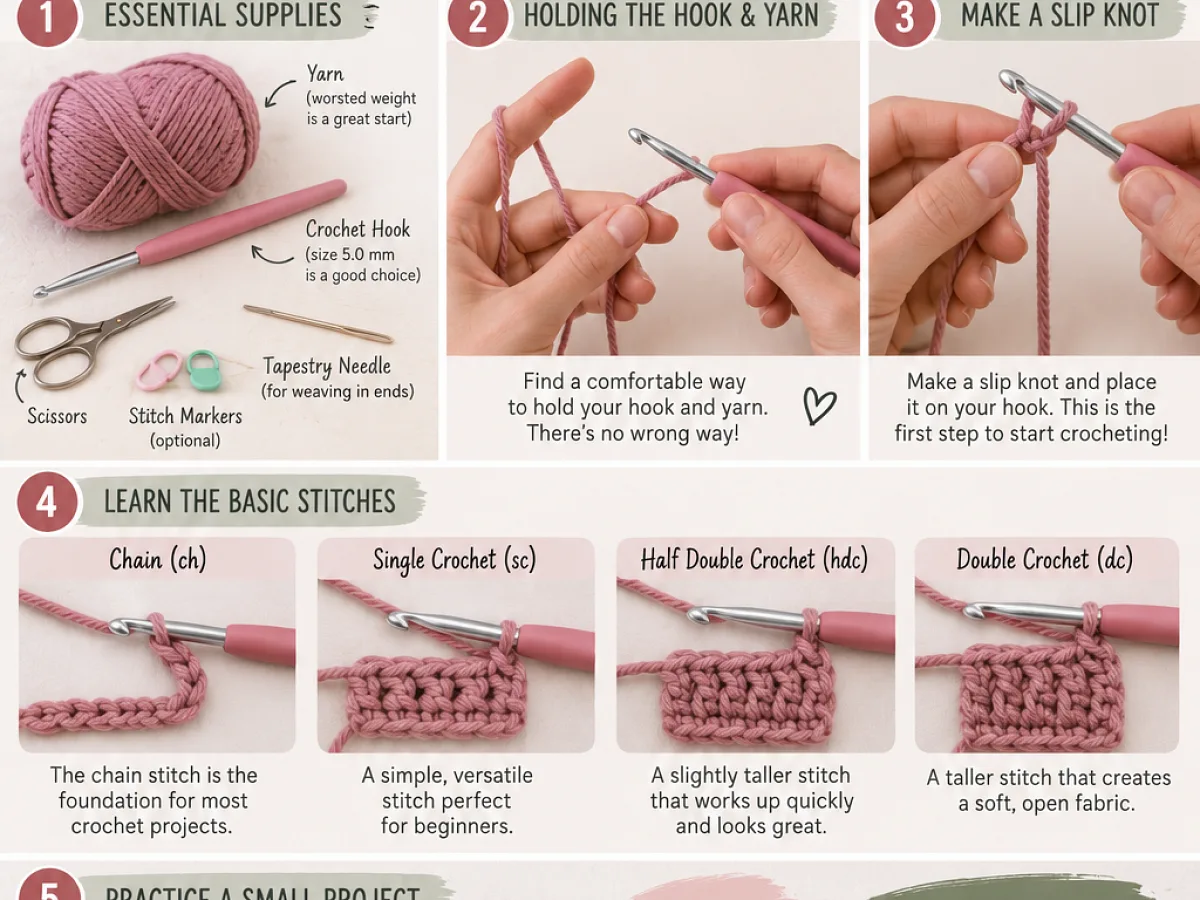
Crochet hook
One size H-8 (5.0 mm) metal hook is enough to start. A single hook costs a few dollars; a full set is not needed yet.
Worsted weight yarn
Look for number 4 on the label. One 200 g ball in a light color is plenty for practice and a first dishcloth.
Scissors
Any small pair works. Keep them with your yarn so you are not hunting for them mid-row.
Yarn needle
A blunt-tipped needle with an eye wide enough for worsted yarn. Used to weave in the ends when the piece is finished.
What you actually need before the first stitch
Buy one hook, not a set. A size H-8 (5.0 mm) hook is the middle of the range and works with worsted weight yarn, which is the yarn sold in almost every craft shop. A metal hook slides faster than bamboo, so beginners often find it easier.
For yarn, choose a light color in worsted weight, labeled number 4 on the wrapper. Dark yarn hides your stitches and fuzzy yarn grabs the hook. Smooth cotton or acrylic in cream, pale grey or light blue lets you see every loop.
You do not need stitch markers, a gauge ruler or a pattern yet. A pair of scissors and a yarn needle for later are the only extras worth having on the table.
- One H-8 (5.0 mm) hook
- One ball of worsted weight yarn, number 4, light color
- Scissors
- A yarn needle for weaving in ends
If the yarn splits while you work, the hook is catching the strands instead of the whole loop. Try a hook one size larger.
Hold the hook and yarn so your hands stop fighting
Hold the hook like a knife, with your thumb and first two fingers near the head. Some people hold it like a pencil instead. Both work, and neither is wrong.
The yarn runs from the ball over your index finger and under your middle finger. Your index finger decides how tight each loop sits. If the yarn feels tight, lift that finger a little.
Your non-hook hand does most of the work. It feeds yarn and keeps the tension steady, while the hook hand only turns and pulls.
If your hands ache after ten minutes, put the work down and stretch. Beginners grip far harder than they need to.
Start with a slip knot and a chain
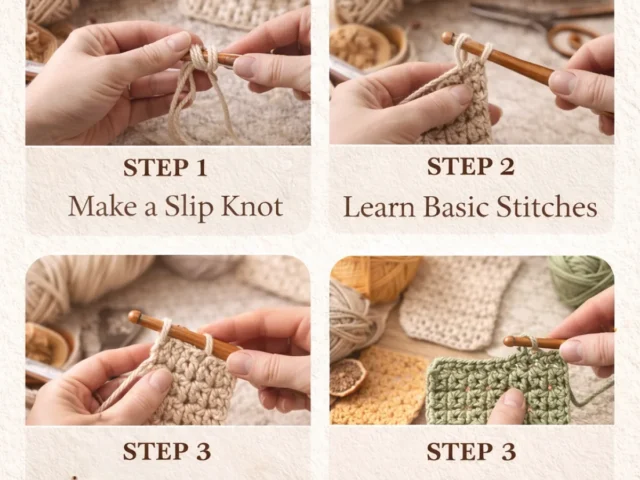
Make a loop, cross the tail over the working yarn, and pull a new loop through the middle. Slide it onto the hook and tug the tail until it sits snug but still slides.
Wrap the yarn over the hook, from back to front, and pull it through the loop on your hook. That is one chain. Do it fifteen times and count as you go.
The front of a chain looks like a row of small V shapes. If yours twist or stack sideways, the tension is uneven, so pull the yarn a little looser and try again.
Count your chains twice. A chain of 15 is a good practice length, and losing count is the most common beginner mistake.
Single crochet, the stitch everything else builds on
Insert the hook into the second chain from the hook, under both top loops. Wrap the yarn over the hook and pull it back through the chain. You now have two loops on the hook.
Wrap the yarn over again and pull it through both loops. One single crochet is done. Work one into each remaining chain, and you will finish the row with 14 stitches.
For row two, chain one and turn the work. That chain does not count as a stitch. Work your first single crochet into the very first stitch, not the turning chain, or your row will grow by one stitch every time.
If your edges slope outward, you are adding a stitch at the start. If they pull inward, you are skipping one.
Half double crochet and double crochet
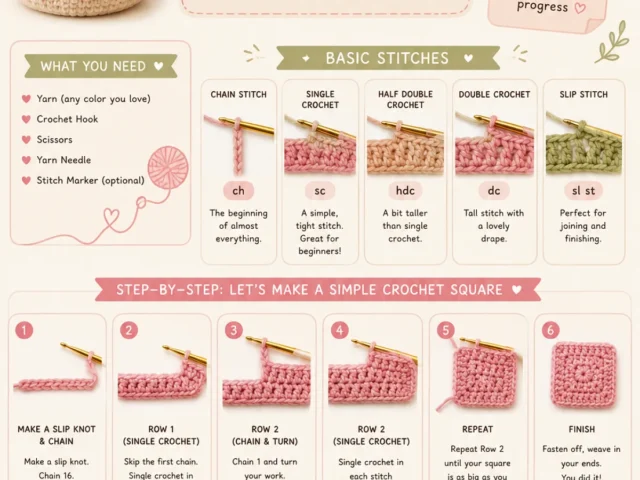
Half double crochet adds one wrap before you insert the hook. Wrap the yarn over, insert into the stitch, pull up a loop, then pull through all three loops at once. It is taller than single crochet and works up faster.
Double crochet adds one more step. Wrap the yarn over, insert the hook, pull up a loop, then pull through two loops, then through the last two. It stands about twice as tall as single crochet.
Both stitches start in the third chain from the hook when you begin a new row, because the turning chain replaces the first stitch. Counting those chains correctly is where most beginners lose stitches.
- Single crochet: two loops on the hook, pull through both
- Half double crochet: three loops on the hook, pull through all three
- Double crochet: three loops on the hook, pull through two, then two
Practice each stitch on a 15 chain swatch before moving on. Ten minutes on one stitch beats an hour switching between three.
How to tell it is going right
Lay the work flat and look at the top edge. It should be a straight line of V shapes, all the same size. If one stitch is much taller, you pulled the loop too high.
Count your stitches at the end of every row for the first few rows. A row of 14 should stay 14. When it changes, undo back to the last correct row rather than carrying the mistake forward.
Your first swatch may lean or ripple. Blocking, which means dampening the piece and pinning it flat to dry, fixes small unevenness in cotton and wool but not in acrylic.
A finished beginner swatch in worsted weight works up to roughly 10 cm (4 in) square after about 14 stitches and 16 rows. That is your gauge check.
What to make first
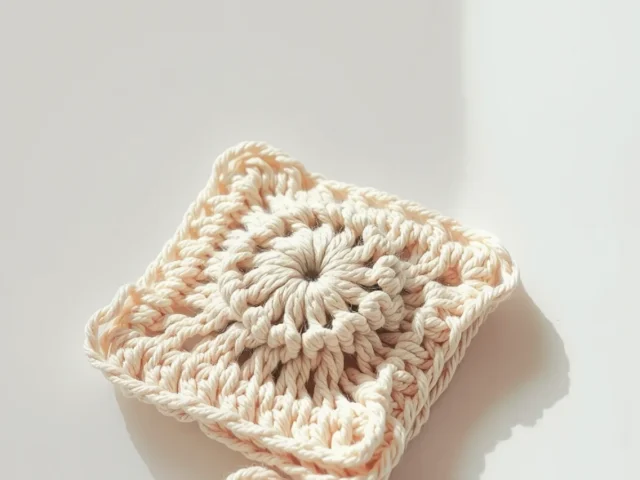
A dishcloth is the best first project. It is a square of single crochet, about 20 cm (8 in) across, worked until it looks square. Nothing has to fit anybody.
A scarf comes next. Work in half double crochet until the scarf measures about 15 cm (6 in) wide and 150 cm (60 in) long. A scarf does not need a gauge, so small changes in your tension will not ruin it.
Save hats and garments for later. They need a gauge that matches the pattern, and your tension will still be changing for the first few projects.
Weave in the yarn tails with a yarn needle before you use the piece. Knots work loose in the wash.
Step
Make the slip knot
Loop the yarn, pull a new loop through it, and slide it onto the hook. Tug the tail until the loop slides but does not slip off.
Chain 15
Wrap the yarn over the hook and pull it through the loop. Count each chain. You should see 15 V shapes along the top.
Work the first single crochet row
Insert the hook into the second chain from the hook, pull up a loop, wrap, and pull through both loops. Work one stitch into each chain and finish with 14 stitches.
Turn and work row two
Chain one, turn the work, and work your first stitch into the first stitch of the previous row. Count again at the end. The count should still be 14.
Try half double and double crochet
Work a row of each on a fresh 15 chain swatch. Check that the turning chain matches the stitch height before you count the first stitch.
Finish and weave in the ends
Cut the yarn, leaving a 15 cm (6 in) tail, pull it through the last loop, and thread it into the fabric with a yarn needle.
Ways to change it
Cotton instead of acrylic
Cotton has less stretch and shows stitch definition clearly. It suits dishcloths and washcloths but feels firmer in the hand.
Chunky yarn and a larger hook
A size L-11 (8.0 mm) hook with bulky weight yarn makes bigger stitches that are easier to see. Good if your eyes tire on small work.
Left-handed version
Mirror every movement. The yarn still runs over your index finger, and rows still turn at the end of each one.
A larger first project
Keep the same single crochet stitch and work until the piece is 30 cm (12 in) wide for a small blanket square.
A tighter gauge
Drop to a size G-6 (4.0 mm) hook for a denser fabric. Useful for potholders, where loose stitches let heat through.
The short version
- A slip knot, a chain and single crochet are the only three skills you need for a first project.
- An H-8 (5.0 mm) hook with worsted weight yarn is the standard starting pair.
- Counting stitches at the end of every row catches mistakes before they spread.
- A 15 chain swatch makes a practice piece of about 14 stitches per row.
- Half double and double crochet are the same motion with one extra yarn wrap.
- Your tension will change over the first few projects, so don't worry about gauge yet.
- Weave in the ends with a yarn needle rather than tying knots.
Questions people ask
What is the easiest crochet stitch for a beginner?
Single crochet. It uses one loop at a time and gives a firm, even fabric that is easy to count. Work a few rows of it before you try anything taller.
How long does it take to learn to crochet?
The slip knot and chain take about ten minutes to get comfortable with. Most people can work a straight row of single crochet within half an hour of practice.
What size crochet hook should a beginner use?
A size H-8 (5.0 mm) hook works with worsted weight yarn, which is the most common weight in shops. It is big enough to see your stitches and small enough to control.
Why does my crochet get wider every row?
You are probably working a stitch into the turning chain at the start of the row. That chain replaces the first stitch, so skip it and start in the first real stitch.
Can I learn to crochet left-handed?
Yes. You hold the hook in your left hand and mirror every movement. Written patterns work the same way, and many video tutorials are filmed for left-handed crocheters.
How do I know when my crochet piece is finished?
When it measures the size you planned, or when the yarn runs out. For a dishcloth, stop when the piece is square, roughly 20 cm (8 in) on each side.
Pick up your hook and work one row of single crochet today
Start with the slip knot and a chain of 15, then work one row of single crochet. That single row teaches your hands more than any video can. When the piece is done, wash cotton dishcloths in warm water and lay them flat to dry so the shape holds. Stitch with ease.