Just Starting Crochet: Your First Stitches, Supplies, and a Simple Project
Learn four basic stitches, pick the right yarn and hook, and finish a small square you can actually use.
A size H hook with worsted weight yarn is the pair most beginners learn on, and it costs about as much as two coffees.
Crochet is one loop pulling through another, over and over. That is the whole craft. Everything else is just where you put the hook.
This guide walks you through the supplies, the four stitches you need first, and one small project that teaches all of them at once. No prior skill needed.
You need one hook, one ball of yarn, and four stitches: slip knot, chain, single crochet, and double crochet. Start with a light-colored worsted yarn and a 5.0 mm hook, and practice a 20-stitch square before you attempt anything bigger.
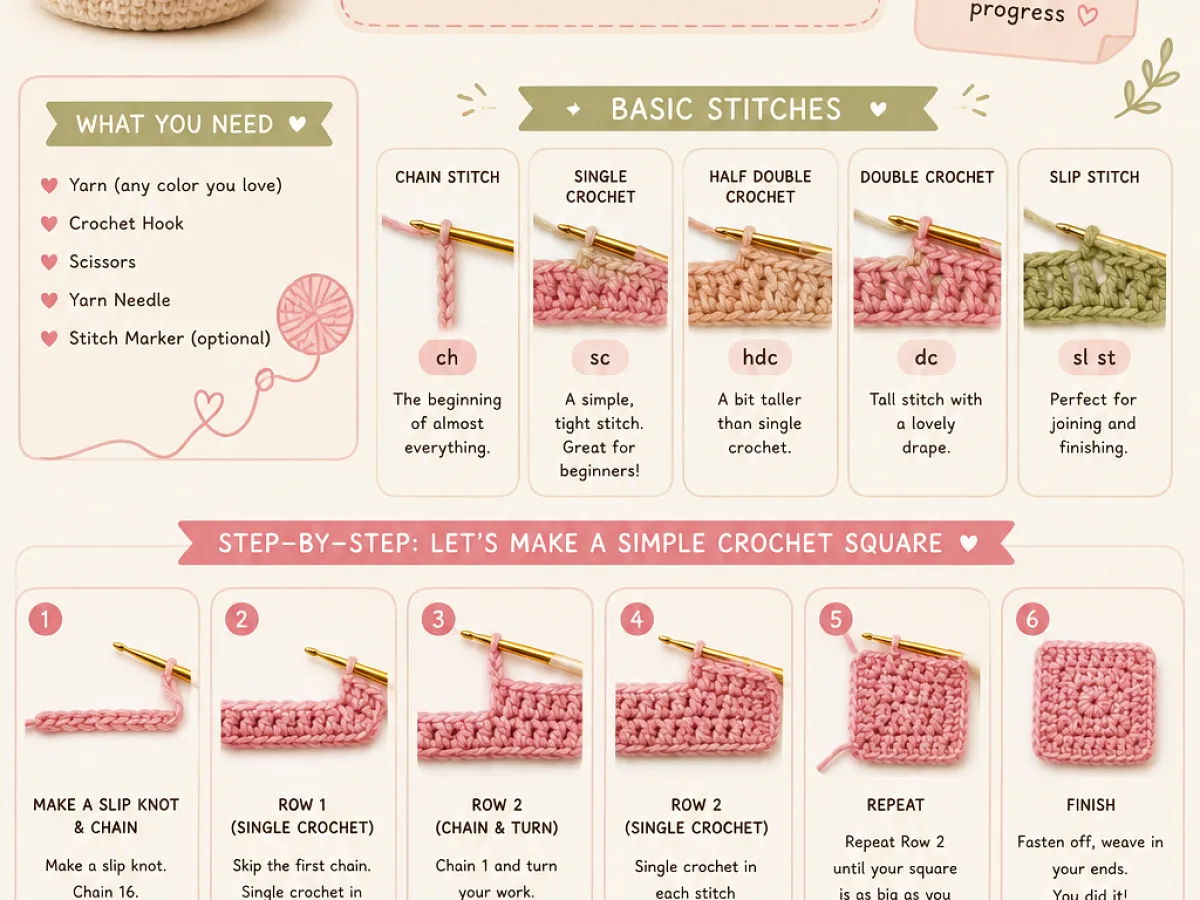
What you need
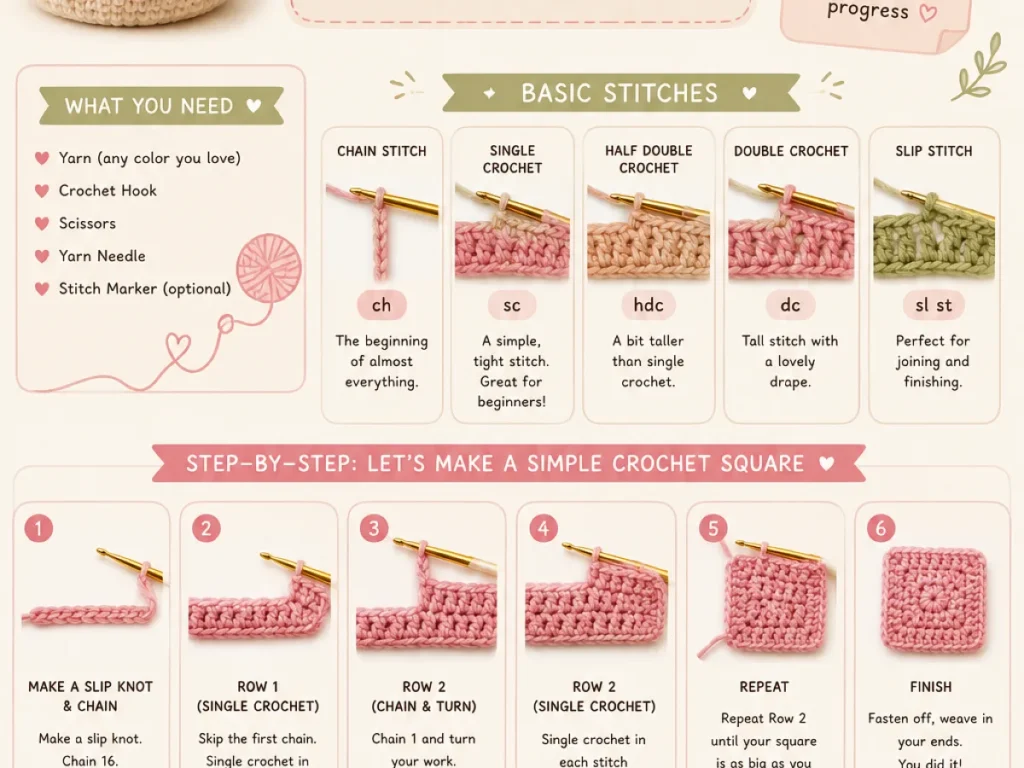
Worsted weight yarn
One 100 g ball in a light color such as cream or pale gray. Acrylic is cheap and forgiving; cotton shows stitch definition better.
5.0 mm (H) hook
Aluminum or ergonomic handle, whichever feels better in your hand. A 5.5 mm hook works if your stitches come out tight.
Blunt yarn needle
For weaving in ends. A plastic one is fine and will not split the yarn.
Small scissors
Any sharp pair. Keep them with your project so you do not lose them in the couch.
What you actually need to start
Buy less than you think. One hook and one ball of yarn will keep you busy for a week. The rest can wait until you know you like it.
- A 5.0 mm (H) hook. Aluminum is fine and cheap.
- One ball of worsted weight yarn, light color. Dark yarn hides your stitches and your mistakes.
- A pair of small scissors and a blunt yarn needle for weaving ends.
If worsted feels clumsy in your hands, try DK weight with a 4.0 mm hook. The stitches come out smaller but easier to see.
How to hold the yarn and hook
Hold the hook like a pencil or like a knife. Both work. Pick whichever lets your wrist stay relaxed after ten minutes.
The yarn runs over your index finger and under your pinky and ring finger. That tension is what keeps your stitches even. Too loose and the loops slide off. Too tight and you cannot get the hook back in.
If your hand cramps, you are gripping too hard. Set it down for five minutes. This is normal in the first week.
The four stitches to learn first
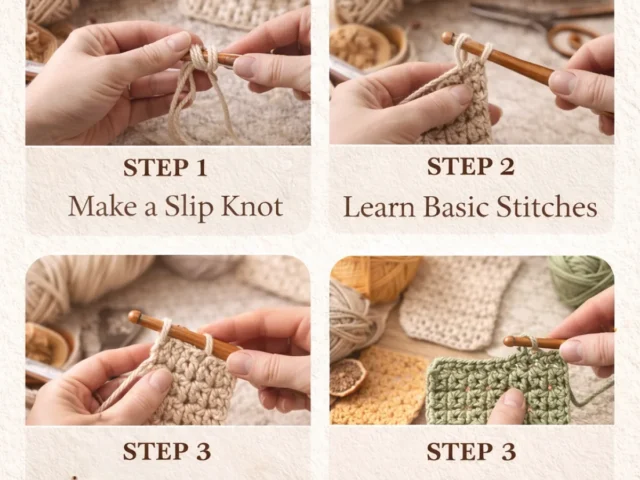
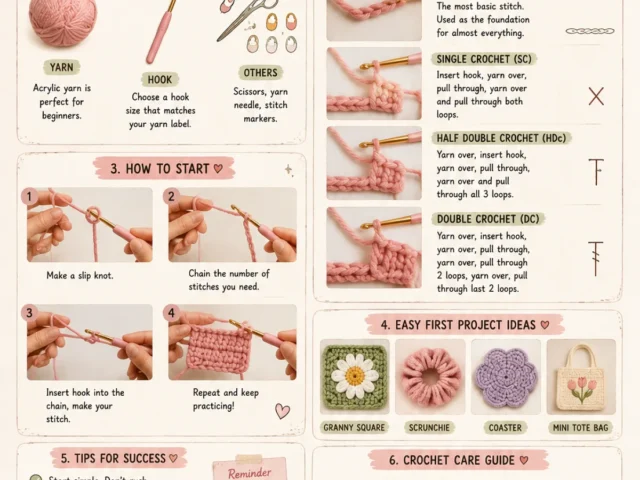
Slip knot: loop the yarn, pull the tail through, and tighten it on the hook. It should slide but not slip off.
Chain (ch): yarn over, pull through the loop. That is one chain. Make twenty and count them. If you get nineteen, you are not alone.
Single crochet (sc): insert the hook into the next chain, yarn over, pull up a loop, yarn over again, pull through both loops. Two loops become one.
Double crochet (dc): yarn over first, insert the hook, yarn over, pull up a loop, yarn over and pull through two loops, yarn over and pull through the last two. Taller than single crochet, and faster to work.
Written chart for a practice row: ch 21, skip the first ch, sc in each ch across. You should end with 20 sc. If you have 19 or 21, count again before ripping anything out.
Reading your own stitches
Each stitch looks like a small V from the top and a post from the side. The V is where the next stitch goes. If you insert your hook under both legs of the V, your edges stay straight.
The last stitch of a row hides near the turning chain. Skipping it is the most common reason a square turns into a triangle. Count at the end of every row for the first few projects.
If you cannot tell where the last stitch is, put a removable stitch marker in the first stitch of each row. Move it up as you go.
Your first project: a 15 cm practice square
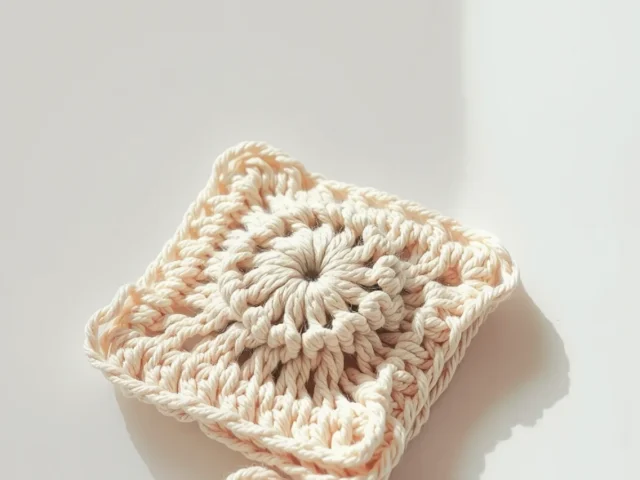
This square teaches chain, single crochet, and turning. Make four and you have a coaster set. Make sixteen and you have a small blanket.
- Finished size: about 15 cm by 15 cm.
- Gauge: 14 single crochet and 16 rows to 10 cm. Gauge matters here only if you plan to join squares later.
- Stitch count: 21 single crochet across, 32 rows.
Finishing and joining
Cut the yarn leaving a 15 cm tail. Pull it through the last loop and tighten. Thread the tail onto a blunt needle and weave it back through four or five stitches, then turn and weave the other direction. That locks it without a knot.
To join squares, hold them right sides together and single crochet through both edges. Or whipstitch with the needle if you want a flatter seam.
Weave ends before you block, not after. Blocking opens the stitches and makes the tails harder to hide.
Step
Make a slip knot
Loop the yarn and pull the tail through. Slide it onto the hook and tighten until it moves but does not slip off. If it slides freely, it is right.
Chain 21
Yarn over and pull through the loop. Count as you go. You should have 21 chains and one loop still on the hook.
Work the first row of single crochet
Skip the first chain, then single crochet into each chain across. You should end with 20 stitches. Count them before turning.
Turn and chain one
Turn the work like a page in a book. Chain one. That chain does not count as a stitch in single crochet.
Repeat for 32 rows
Single crochet into each stitch across, chain one, turn. Check your count every few rows. The square should stay even on both sides.
Fasten off and weave ends
Cut a 15 cm tail, pull it through the last loop, and tighten. Weave the tail through four or five stitches in two directions.
Ways to change it
Coaster set
Make four squares in the same yarn and stack them. Good first gift.
Cotton instead of acrylic
Cotton has less stretch, so stitches look cleaner. It is also stiffer on the hands at first.
Bigger hook, chunkier yarn
A 6.5 mm hook with bulky yarn makes a square in half the time. Good if worsted feels fiddly.
Two colors
Change color at the end of a row and carry the old yarn up the side. Hides the join inside the edge.
Granny square next
Once your square is even, a granny square teaches clusters and corners in one go.
The short version
- One hook and one ball of yarn is enough to start.
- Worsted weight with a 5.0 mm hook is the standard beginner pair.
- Counting stitches at the end of every row prevents most mistakes.
- The last stitch of a row is the one beginners miss most.
- A 15 cm square takes about 1 to 2 hours and teaches three stitches.
- Gauge only matters when you join pieces or follow a fitted pattern.
Questions people ask
What is the easiest crochet stitch for a total beginner?
Single crochet. It uses one loop at a time and builds height slowly, so you can see what you are doing. Chain stitch comes first because every project starts with it.
Why does my crochet get wider every row?
You are adding a stitch, usually at the start or end of the row. Count your stitches after each row. If the number grows, pull back to the last correct row.
How do I know what hook size to use?
Check the yarn label. It lists a suggested hook size, usually between 4.0 mm and 6.0 mm for worsted. Start there and adjust if your stitches feel too tight or too loose.
Can I learn crochet with cotton yarn?
Yes. Cotton does not stretch, so mistakes are easier to see. It is a little harder on the hands than acrylic, so many people start with acrylic and switch later.
How long does it take to learn the basics?
Most people can chain and single crochet within an hour, and finish an even square in a weekend of short practice sessions. Ten minutes a day beats one long session.
Grab a hook and make your first square today
Start with one square. Once your edges stay straight and your count holds at 20, you are ready for a granny square or a simple scarf. Stitch with ease.