How to Read Crochet Patterns
Learn to read any crochet pattern, from abbreviations to charts, and start your next project with confidence.
The first time you open a crochet pattern, it can look like a secret code.
The first time you open a crochet pattern, it can look like a secret code. There are letters like "sc" and "dc," numbers in parentheses, and maybe a diagram full of symbols. But it really is not that hard once you learn the key.
This guide walks you through the anatomy of a pattern, explains the abbreviations, and shows you how to follow the instructions row by row. You will also learn how to read a stitch chart, which many crocheters find easier than text.
Reading a crochet pattern is about understanding the abbreviations, the structure, and the stitch symbols. Once you know the basics, you can follow any pattern step by step.
What you need
Yarn
Choose the weight the pattern calls for. If you substitute, you may need to adjust your hook size and gauge.
Crochet hook
Use the size recommended in the pattern. The hook size affects your gauge and the tightness of your stitches.
Stitch markers
Useful for marking the first stitch of a round or a specific spot in your work.
Tape measure
To check your gauge and measure your work as you go.
Scissors
For cutting yarn at the end.
Why Patterns Look So Confusing at First
Patterns are written in a shorthand that saves space. Instead of writing "single crochet," they write "sc." Instead of saying "repeat this part three times," they put it in parentheses with a number after it, like "(sc, hdc) 3 times."
This is great once you know the code, but it can feel like a foreign language at the start. The good news is that the code is consistent across most patterns, so once you learn it, you can read almost any pattern.
Keep a list of common abbreviations near you. You will memorize them faster than you think.
The Anatomy of a Crochet Pattern
Most patterns follow the same structure. At the top, you will see the skill level, finished size, and the materials needed. Then come the gauge and the abbreviations. After that, the instructions begin, often with a foundation chain and then row by row.
Pay attention to the materials and gauge first. Using the right yarn weight and hook size matters. If your gauge is off, your finished piece will be the wrong size, even if you follow the instructions perfectly.
- Skill level: beginner, easy, intermediate, advanced
- Materials: yarn weight, hook size, other notions
- Gauge: stitches and rows per inch or 4 cm
- Abbreviations: a list of the special terms used
- Instructions: the actual steps, often in rows or rounds
Take a photo of the materials and gauge section on your phone. That way you have it with you when you buy yarn.
Understanding Abbreviations and Terms
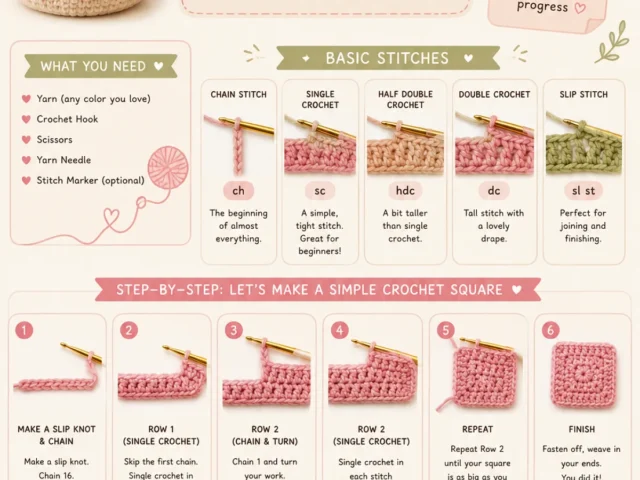
Abbreviations are the building blocks. The most common ones are ch for chain, sc for single crochet, hdc for half double crochet, dc for double crochet, and tr for treble crochet. You will also see sl st for slip stitch and sk for skip.
Some patterns use US terms, others use UK terms. They sound the same but mean different stitches. For example, US single crochet is UK double crochet. Always check which version the pattern uses before you start.
If you are following a UK pattern with US skills, just double the stitch name. UK double crochet is US single crochet.
How to Follow Written Instructions
Written instructions are usually broken into rows or rounds. Each line tells you what to do for that row. For example, "Row 1: ch 1, sc in each ch across. Turn." That means you chain one, then work one single crochet into every chain stitch from the previous row, and then turn your work.
When you see parentheses, like "(sc, hdc) 3 times," it means you repeat the sequence inside the parentheses three times in a row. Brackets are used for larger repeats, and sometimes an asterisk tells you where to start repeating from.
Use a highlighter or a row counter to keep your place. It is easy to lose track, especially in long patterns.
Reading Stitch Charts and Diagrams
A stitch chart is a picture of your crochet work. Each stitch has a symbol. For example, a single crochet is often a short cross, and a double crochet is a longer cross with one or more slashes. The chart shows you exactly where to place each stitch, row by row.
Charts are especially useful for lace patterns and motifs. They let you see the overall shape and how the stitches fit together. Many crocheters find them easier than following long written instructions.
If a pattern gives both written and chart instructions, read the chart first. It gives you the big picture, and then the written row-by-row helps with the details.
Common Mistakes and How to Fix Them
One common mistake is miscounting stitches. If your row has too few or too many, the edges will slant or ripple. Always count your stitches at the end of each row, especially when you are starting.
Another is turning chain confusion. The turning chain at the start of a row often counts as the first stitch. If the pattern says "ch 3 (counts as dc)," then you work into the next stitch, not the base of the chain. If you are unsure, check the pattern notes.
If you make a mistake, you can often just pull out the stitches back to the error. Crochet is forgiving that way.
Tips for Beginners
Start with a simple pattern that uses basic stitches. A scarf or a dishcloth is perfect. Read the whole pattern through once before you begin, so you know what to expect.
Do not worry about speed. The more you practice, the faster you will get. And if you get stuck, there are plenty of online videos and communities to help.
Keep a notebook with notes about what works for you. You will develop your own preferences.
Step
Check the materials and gauge
Look at the top of the pattern for yarn weight, hook size, and gauge. Make a small swatch to test your gauge before you start the actual project.
Read the abbreviations
Find the list of abbreviations and read through it. If a symbol is new, look it up or watch a quick video.
Work a foundation chain
Most patterns start with a chain. Count your chains carefully. The pattern will tell you if the chain counts as a stitch.
Follow row by row
Work each row as written. Use a row counter or a piece of paper to mark your place. Count your stitches at the end of each row.
Finish off
When you reach the end, cut your yarn, pull it through the last loop, and weave in the ends with a yarn needle.
Ways to change it
Learn with video
Some people learn better by watching. Look for video tutorials that demonstrate the stitches in real time.
Try a chart pattern
If written instructions confuse you, try a pattern with a stitch chart. The visual layout can be much clearer.
Use stitch markers
Mark the first and last stitch of each row to avoid losing your place, especially when working in the round.
Start with a small project
A washcloth or a scarf uses basic stitches and is quick to finish. This builds your confidence.
Join a crochet group
Online forums or local meetups can offer support and answer questions when you get stuck.
The short version
- Patterns use abbreviations to save space; learn the most common ones first.
- Always check whether the pattern uses US or UK terms.
- Gauge matters: test it before you start a project.
- Parentheses and brackets tell you to repeat a sequence.
- Stitch charts give a visual map of your work.
- Counting stitches at the end of each row prevents mistakes.
- Start with simple patterns and practice regularly.
Questions people ask
What does 'sc' mean in a crochet pattern?
'sc' stands for single crochet. It is a basic stitch where you insert your hook, yarn over, pull through, yarn over, and pull through two loops.
How do I know if a pattern uses US or UK terms?
Check the pattern's notes or the abbreviations list. US single crochet is called double crochet in UK terms. Many patterns specify which terms they use.
What is a stitch chart?
A stitch chart is a diagram where each stitch has a symbol. It shows you where to place each stitch, often row by row, and is helpful for visual learners.
Why is my gauge not matching the pattern?
Your tension might be different. Try a different hook size: a smaller hook makes tighter stitches, a larger hook makes looser ones, until your gauge matches.
Start with a simple pattern and practice reading a few rows today.
Reading crochet patterns is a skill, and like any skill, it gets easier with practice. Start with a small project, keep this guide handy, and soon you will be reading patterns like a pro. Stitch with ease.