35 Crochet Granny Square Designs
Thirty-five square patterns, sorted by skill, with the hook size and yarn weight each one wants.
A basic granny square takes about twenty minutes once you stop losing your place in the corner chain.
Most granny squares fail for one boring reason: the corner gets three chains when it needed two, and the whole thing curls into a bowl.
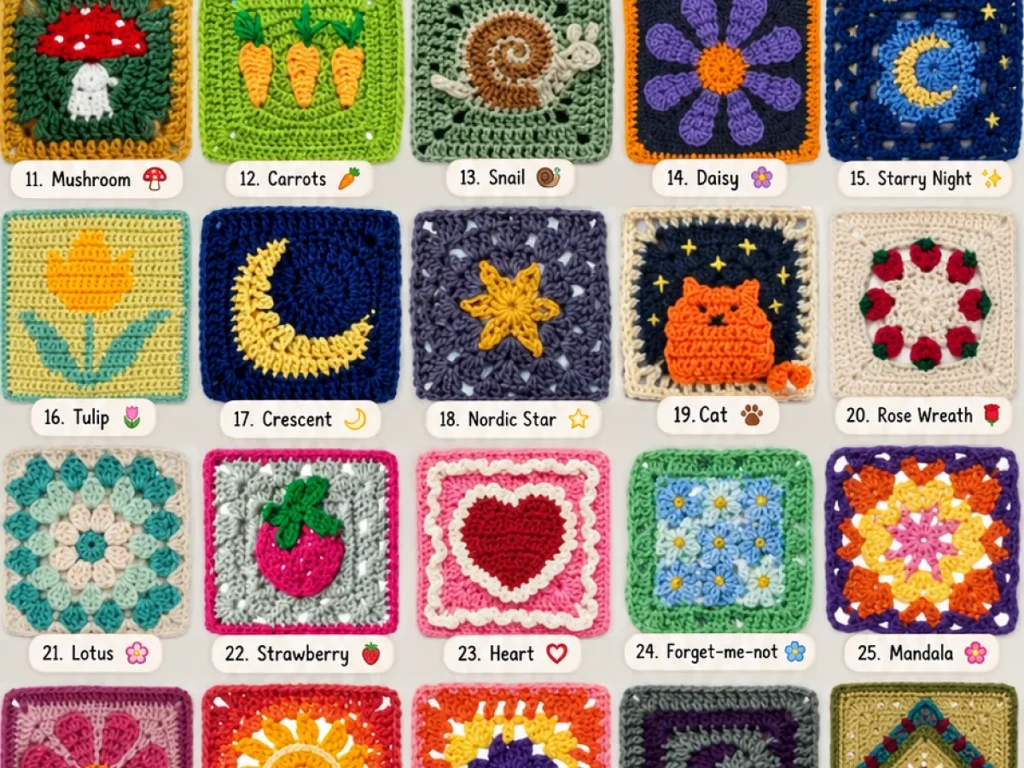
Below are 35 designs, from the plain three-round square up to lace and flower centres. Pick by skill and by what yarn is already in your basket.
This is a list of 35 granny square designs you can crochet, grouped by how hard they are and what yarn they suit. Each entry tells you the yarn weight, hook size and finished size, so you can pick one and start without guessing.
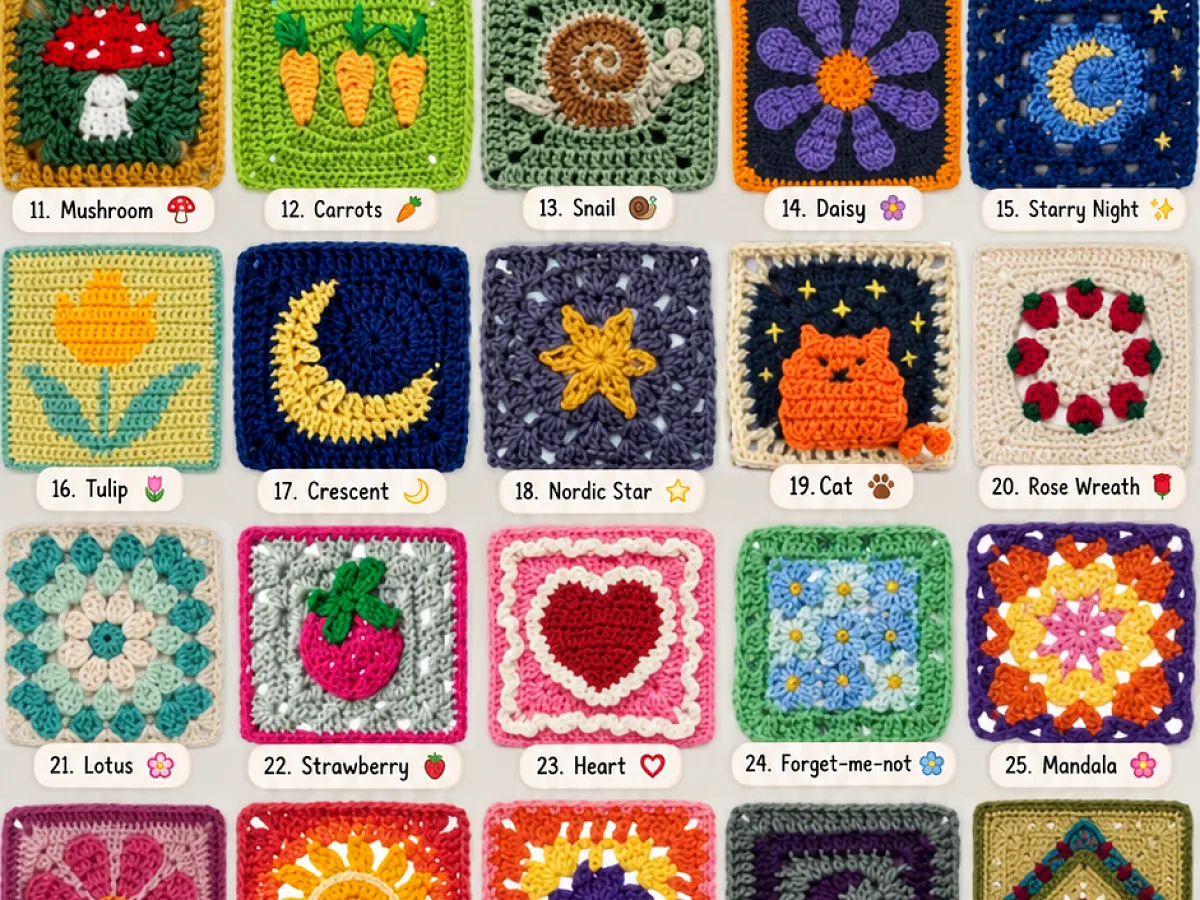
The collection
Classic three-round square
Three rounds, four corners, about 12 cm in worsted. The one to learn first.
Solid colour square
Same shape, no colour changes, so there are only two ends to weave in.
Two-colour centre
Round one in a contrast colour, rounds two and three in the main colour.
Striped rounds
A new colour every round. Expect six ends per square.
Single crochet square
Denser fabric, good for potholders and bags.
Corner-start square
Begins at one corner instead of the centre. Useful for joining as you go.
Chunky five-round
Super bulky yarn on an 8 mm hook. One square covers your palm.
Baby blanket square
Soft DK in pastel shades, about 9 cm across.
Scrap square
Changes colour whenever the current ball runs out.
Joined-as-you-go basic
The last round attaches to the previous square, so no sewing later.
Flower centre
A five-petal motif in round one, squared off in round two.
Sunburst
Radiating clusters in three colours, popular for cushion covers.
Post-stitch texture
Front and back post stitches create raised ribs.
Ripple square
Wavy sides that need blocking to sit flat.
Mitered square
Worked corner to corner with decreases on one diagonal.
Hexagon
Six sides instead of four. Joins into honeycomb layouts.
Circle in a square
A round motif set inside a square border.
Two-tone corner
Only the corners change colour, which makes a diamond when joined.
Cluster square
Three or four part stitches worked together as one.
Puff stitch square
Soft raised puffs, best in smooth yarn so they do not fuzz.
Shell square
Groups of five stitches fan out from each space.
Popcorn square
Five-stitch popcorns that sit proud of the fabric.
Lace square
Open chain spaces. Uses less yarn but shows every mistake.
Pineapple square
A classic chart motif with a fan base and a pointed top.
Filet chart square
Follows a grid of filled and open blocks to draw a picture.
Joined motif square
Small motifs made first, then linked into one square.
Overlay square
A second colour laid over the first with long front-loop stitches.
Star stitch square
Clusters pulled into a star shape, denser than it looks.
Cable square
Crossed post stitches running up the square.
Mandala centre
Many rounds in fine yarn, often 20 cm or more across.
Cathedral window
Folded squares stitched over a base. Heavy on yarn.
Mosaic square
Two colours, one row at a time, no carrying both across.
Tapestry-style colourwork square
Colour changes inside a row to draw a shape. Needs bobbins.
Three-dimensional flower square
The flower sits on top of the square instead of inside it.
Continuous join square
One long joining round links a whole strip without cutting yarn.
What you need
Yarn
Worsted weight (Category 4) is the easiest to learn on. DK weight works too but the squares come out smaller.
Crochet hook
5 mm for worsted, 4 mm for DK. Metal hooks slide faster, but wooden ones grip slippery cotton better.
Tapestry needle
A blunt needle with an eye wide enough for your yarn. Used for weaving in ends and for whip-stitch joins.
Stitch markers
You need at least four for the corners. Paper clips work if you have none.
Tape measure
Any soft tape. You will check the square size after every few rounds.
How to pick a square that suits your yarn
Yarn weight decides everything. A worsted weight yarn (Category 4) with a 5 mm hook gives you a square about 12 cm across after four rounds. A DK weight (Category 3) with a 4 mm hook lands nearer 9 cm.
If you swap yarn without swapping hook, the square changes size, and squares that differ by even 5 mm will not sit flat when you join them. Make one square first. Measure it. Then decide how many you need.
Write the yarn name and hook size on a scrap of paper and keep it with the project. Six weeks later you will not remember which pink you used.
The stitches and abbreviations you need
Every pattern here uses the same short list. Learn these and you can read all 35.
Chain is ch. Slip stitch is ss. Double crochet is dc in UK terms and single crochet is sc. In US terms those two swap names, which is the single most common reason a pattern comes out wrong.
- ch – chain
- ss – slip stitch
- dc – double crochet (UK) / single crochet (US)
- tr – treble crochet (UK) / double crochet (US)
- sp – space
- rep – repeat
Check the top of the pattern for UK or US before you start. A US dc and a UK dc are different stitches.
The classic three-round square
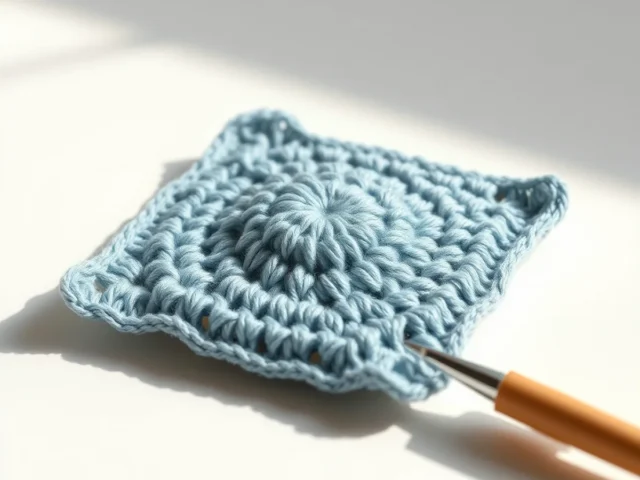
This is the one almost everyone learns first. Chain four, join into a ring. Round one: three chain, two dc into the ring, chain two, then three dc, chain two, three times more. Join. Round two and three work clusters into the chain-two spaces at each corner.
The corner space is where it goes wrong. If you put three chains in the corner instead of two, the square grows a point. If you put one, the corner pulls tight and the square will not lie flat.
A finished square in worsted weight on a 5 mm hook measures about 12 cm after three rounds. That is roughly 36 stitches around the outside.
Count your clusters at the end of each round. Round three should have 12 clusters, four on each side.
35 designs, grouped by skill
Beginner squares use only chain, slip stitch and one or two basic stitches. Intermediate squares add colour changes, post stitches or working in the round without turning. Advanced squares use lace, joined motifs or filet charts.
You do not have to work them in order. Pick one that matches your yarn and your patience for that evening.
- Beginner: classic three-round, solid colour, two-colour centre, striped rounds, single-crochet square, corner-start square, chunky five-round, baby-blanket square, scrap square, joined-as-you-go basic
- Intermediate: flower centre, sunburst, post-stitch texture, ripple square, mitered square, hexagon, circle-in-a-square, two-tone corner, cluster square, puff stitch square, shell square, popcorn square
- Advanced: lace square, pineapple square, filet chart square, joined motif square, overlay square, star stitch square, cable square, mandala centre, cathedral window, mosaic square, tapestry-style colourwork square, three-dimensional flower square, continuous join square
The cathedral window and the mandala centre both eat yarn. Budget about 40 g of worsted per square instead of the usual 25 g.
Joining and finishing so the blanket lies flat
Join with a slip stitch through both loops for a firm seam, or with single crochet for a raised ridge. A whip stitch through the back loops only gives the flattest join and hides the seam.
Block every square before joining. Pin them to a towel, mist with water until damp, and leave them 24 hours. Acrylic needs steam instead of water, held a few centimetres above the fabric, never touching the iron to the yarn.
Join in the same direction every time. Flip-flopping the seam direction makes one side of the blanket pucker.
What goes wrong and how to fix it
Curling corners mean too few stitches in the corner space. Pull the round back and add one chain.
A square that grows wider each round means you are adding stitches at the sides instead of only at the corners. Count the clusters on one side after each round.
Colour jog at the join is normal when you change colour mid-round. Finish the last stitch of the old colour, then pull the new colour through the final loop. That hides the step.
If a square measures more than 5 mm off from its neighbours, frog the last round and rework it with a smaller hook.
Step
Make a gauge square
Work three rounds in your chosen yarn and hook. Measure across the middle. If it is not about 12 cm in worsted, change hook size and try again.
Check the corners
Lay the square on a flat table. All four corners should sit down without lifting. If one lifts, the corner chain count is wrong.
Block before joining
Pin the square to a towel, mist with water until damp, and leave it 24 hours. Steam acrylic instead of wetting it.
Join in one direction
Whip stitch through the back loops only, working left to right across every seam. Keep the tension loose enough that the seam does not pull.
Weave in the ends
Thread each tail onto a tapestry needle and run it through six stitches on the wrong side, then back through three. Trim close.
Ways to change it
Smaller squares
Drop to DK weight and a 4 mm hook. Each square lands near 9 cm, so you need more of them.
Chunky blanket
Super bulky on an 8 mm hook. Fewer squares, faster finish, heavier blanket.
Cotton for potholders
Cotton holds up to heat and does not melt. Acrylic does melt, so keep it away from hot pans.
One-colour version
Work all 35 designs in the same shade. The texture does the work instead of the colour.
Scrap-busting version
Change colour at every round. Good for using up odd balls, but you get more ends to weave.
Cushion cover
Four squares joined two by two makes a 24 cm cushion front.
The short version
- A worsted square on a 5 mm hook measures about 12 cm after three rounds.
- Corner spaces take two chains, not three. Three makes a point, one pulls tight.
- UK and US double crochet are different stitches, so check the pattern header first.
- Block every square before joining, or the seams will pucker.
- Dense designs like cathedral window use about 40 g of worsted per square instead of 25 g.
- Squares that differ by more than 5 mm will not lie flat together.
Questions people ask
How many granny squares do I need for a blanket?
For a throw about 120 cm by 150 cm, you need roughly 120 squares at 12 cm each, joined five across and twenty-four down. Add a border and the finished size grows by about 4 cm on each side.
What is the best yarn for granny squares?
Worsted weight acrylic is the easiest to learn on and the cheapest to buy in bulk. Cotton gives a firmer square that suits bags and potholders. Wool blocks beautifully but costs more.
Why does my granny square curl?
Too few stitches in the corner spaces, or a hook that is too small for the yarn. Pull the last round back, add one chain to each corner, and try a hook half a millimetre larger.
Can I join granny squares without sewing?
Yes. Work a slip stitch or single crochet join through the edge stitches, or use the join-as-you-go method where the final round of each new square attaches to the one before it.
How long does one granny square take?
A three-round worsted square takes about twenty minutes once you know the pattern. A dense lace or mandala design can take an hour or more.
Pick one square and make it tonight
Start with the classic three-round square in worsted weight on a 5 mm hook. Measure it, block it, and the other 34 designs will make a lot more sense.