Crochet Stitches Tutorial: 12 Essential Stitches for Beginners
Learn 12 essential crochet stitches with clear instructions, common mistakes to avoid, and tips for choosing yarn and hooks.
The chain stitch is the first thing you learn, and it's also the one most people get wrong.
The chain stitch is the first thing you learn, and it's also the one most people get wrong. You might be holding the hook too tight, or your yarn might be twisted. That's okay. Every crocheter has been there.
This guide covers 12 stitches that appear in nearly every pattern. I'll show you how to do each one, what it's used for, and what usually goes wrong. You'll also find tips on yarn and hook sizes, so your stitches come out even.
Grab a light-colored worsted weight yarn and a 5mm hook. That's the easiest combo to see your stitches clearly. Let's start with the foundation.
This tutorial walks you through 12 essential crochet stitches, from chain to double crochet, with step-by-step instructions, common mistakes, and tips for choosing yarn and hooks. By the end, you'll be able to read a pattern and start your first project.
What you need
Yarn
Worsted weight (medium) yarn in a light color. A smooth, non-fluffy yarn is best for seeing stitches. About 200 yards for practice.
Crochet hook
5mm (H-8) hook is a standard size for worsted weight yarn. If you have trouble seeing stitches, try a 6mm hook.
Scissors
Any small scissors will do for cutting yarn.
Yarn needle
A blunt-tip needle with a large eye for weaving in ends.
What You Need to Start
Before you make your first stitch, you need the right tools. A 5mm hook and a skein of worsted weight yarn (about 200 yards) is perfect for practice. The yarn should be smooth and light-colored, like a cream or pastel, so you can see the V shapes of your stitches.
You'll also need a pair of scissors and a yarn needle for weaving in ends. That's it. No fancy equipment.
If you have trouble seeing your stitches, try a larger hook, like 6mm, with the same yarn. The bigger loops are easier to count.
How to Hold the Hook and Yarn
Hold the hook like a pencil or a knife, whichever feels natural. The yarn should flow over your index finger, under your middle finger, and around your pinky. This gives you tension control.
The key is to keep the yarn loose enough to slide but tight enough to keep the loop on the hook. If your stitches are too tight, you won't be able to insert the hook into them later. If they're too loose, your work will look sloppy.
Practice the yarn hold for a few minutes without making stitches. Just let the yarn run through your fingers. It feels strange at first, but it becomes automatic.
The Chain Stitch (ch)
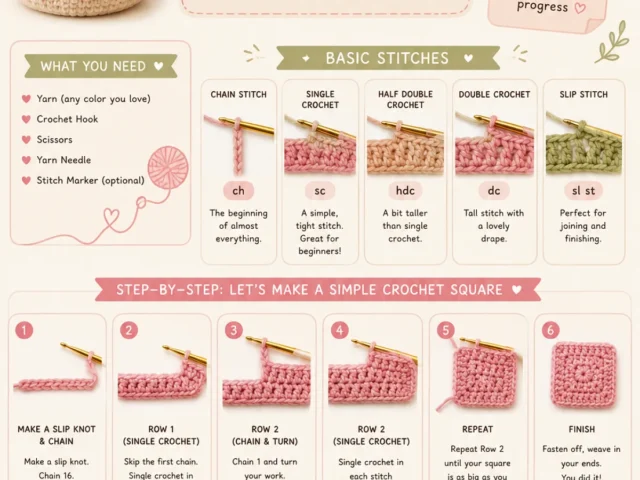
The chain is the foundation of most crochet. Make a slip knot, put it on the hook, and yarn over (wrap the yarn over the hook from back to front). Pull through the loop. That's one chain.
Repeat to make a row of chains. The number of chains you make is the width of your project. For practice, make 20 chains.
The most common mistake is making the chains too tight. You'll know because the hook is hard to insert into the next chain. Loosen your tension by holding the yarn a bit higher.
Count your chains as you go. It's easy to lose track, and a missed chain will show up as a hole in your first row.
Single Crochet (sc)
Single crochet is the tightest and most common stitch. Insert your hook into the second chain from the hook (for the first row), yarn over, and pull up a loop. You now have two loops on your hook. Yarn over again and pull through both loops. That's one single crochet.
Work one single crochet into each chain across. At the end, chain one and turn your work. That chain one is the turning chain, and it counts as the first stitch of the next row.
Common mistake: skipping the turning chain. If your edges look uneven, you're probably missing it. Also, make sure you insert the hook under both loops of the V, not just the front or back loop.
If your edges are wavy, you're adding extra stitches at the ends. Count your stitches at the end of each row. You should have the same number as you started with.
Half Double Crochet (hdc)
Half double crochet is taller than single crochet but shorter than double. Yarn over, insert your hook into the next stitch, yarn over, and pull up a loop. You now have three loops on your hook. Yarn over and pull through all three loops at once.
This stitch is great for blankets because it works up fast and has a nice texture. The turning chain is two chains, which counts as the first half double crochet.
A common mistake is pulling through the loops one at a time. That creates a twisted stitch. Pull through all three at once, in one smooth motion.
If your half double crochet looks lopsided, check that you yarn over before inserting the hook. That's what gives it the extra height.
Double Crochet (dc)
Double crochet is the tallest of the basic stitches. Yarn over, insert your hook into the next stitch, yarn over, and pull up a loop. You have three loops. Yarn over and pull through two loops, then yarn over and pull through the remaining two loops.
The turning chain is three chains, and it counts as the first double crochet. This stitch is used in many patterns, from granny squares to sweaters.
The most common mistake is pulling through the wrong loops. You should always pull through two loops at a time, not all three at once. If you do that, you'll get a stitch that's too short.
To keep your edges straight, always insert the hook into the top of the turning chain at the end of the row. It looks like a V, and it's easy to miss.
Slip Stitch (sl st)
The slip stitch is the shortest stitch. Insert your hook into the next stitch, yarn over, and pull through both loops on the hook. That's one slip stitch.
You use slip stitches to join rounds, move across a row without adding height, or add a decorative edge. It's not used for the body of a project often.
The tricky part is tension. If you pull too tight, the slip stitch becomes hard to see. Keep it loose and even.
When joining a round, slip stitch into the top of the first chain of the round. That closes the circle neatly.
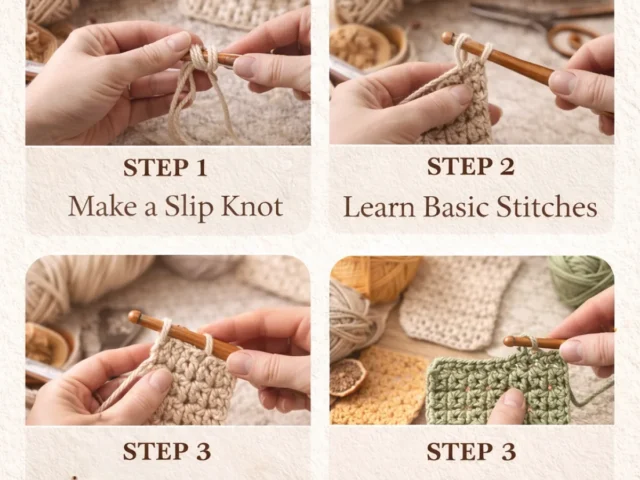
Step
Make a slip knot
Loop the yarn around your fingers, pull a loop through, and tighten it on the hook. It should slide easily but not fall off.
Practice the chain stitch
Yarn over and pull through the loop on the hook. Repeat 20 times. Count as you go. The chain should be even and not too tight.
Work a row of single crochet
Insert the hook into the second chain from the hook, yarn over, pull up a loop, yarn over, pull through both loops. Repeat in each chain across. Chain 1 and turn.
Try half double crochet
Yarn over, insert hook into the next stitch, yarn over, pull up a loop, yarn over, pull through all three loops. Work across, chain 2, turn.
Try double crochet
Yarn over, insert hook into the next stitch, yarn over, pull up a loop, yarn over, pull through two loops, yarn over, pull through two loops. Work across, chain 3, turn.
Practice slip stitch
Insert hook into the next stitch, yarn over, pull through both loops on the hook. Work a few slip stitches along a row.
Ways to change it
Bulky yarn
Use a 6.5mm hook and bulky yarn to make larger stitches that are easier to see. Good for beginners with limited vision.
Cotton yarn
Cotton has less stretch than wool, so it holds its shape well. Great for dishcloths and summer tops.
Ergonomic hook
If your hand cramps, try a hook with a cushioned grip. They cost a bit more but are gentler on your joints.
Tunisian crochet
Uses a longer hook and combines knitting and crochet. A different skill level, but you can learn the basic stitches later.
The short version
- The chain stitch is the foundation of most crochet projects.
- Single crochet is the tightest and most common stitch.
- Half double crochet is taller than single but shorter than double.
- Double crochet is the tallest of the basic stitches and used in many patterns.
- Slip stitch is used for joining rounds and edging.
- Always count your stitches at the end of each row to keep edges straight.
- Use light-colored, smooth yarn to see your stitches clearly.
Questions people ask
What is the easiest crochet stitch for a beginner?
The chain stitch is the easiest because it's the first one you learn. After that, single crochet is the next easiest, since it only involves one yarn over and pulling through two loops.
Why are my crochet edges uneven?
Uneven edges usually happen because you skip the turning chain or add extra stitches at the ends. Count your stitches at the end of each row to catch mistakes early.
How do I fix a too-tight chain?
If your chain is too tight, you can loosen your tension by holding the yarn higher and letting it flow more freely. Or, use a larger hook for the foundation chain, then switch to the pattern hook.
What does 'yarn over' mean?
Yarn over means to wrap the yarn over the hook from back to front. It's the motion you use to create new loops and make stitches.
Now you're ready to start your first project
You've learned the 12 essential crochet stitches. Practice each one until it feels natural, and don't worry about mistakes. They're part of learning. Start with a simple scarf, and you'll be surprised how quickly you improve. Stitch with ease.