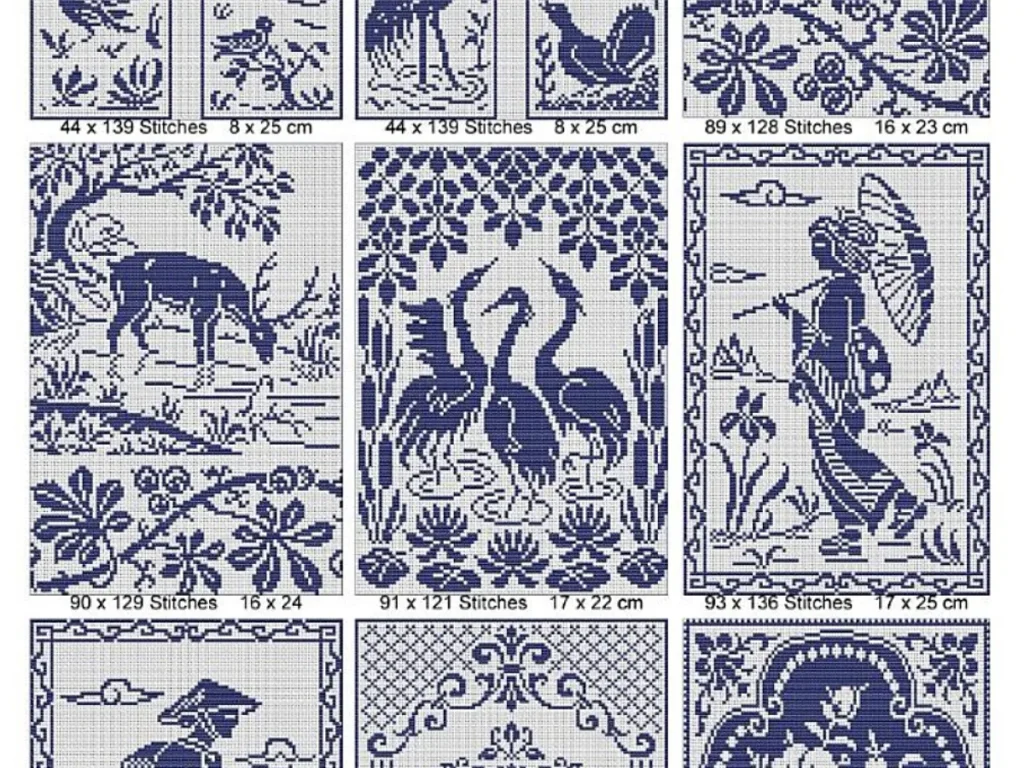
Blue Filet Crochet Pattern Charts Collection
A roundup of blue filet crochet charts that turn simple double crochet into pictures, with tips to read them fast.
Blue filet crochet is just double crochet and chains, but the chart turns it into a picture.
Filet crochet looks fancy, but it is the same stitch over and over. You double crochet into a grid, and the filled squares make the design. Blue is a classic color for it because the contrast shows every square clearly.
You do not need to memorize anything. A chart is like graph paper, and each square on the paper is one stitch or one chain. This collection brings together several blue filet charts, from simple hearts to more involved flowers, so you can pick one that fits your skill and your yarn stash.
Filet crochet uses a grid where filled squares are double crochet and empty squares are chains. A chart shows that grid, and blue yarn makes the pattern pop. This collection gathers several blue filet charts you can stitch as bookmarks, doilies, or wall art.
What you need
Blue yarn
Cotton worsted weight or size 10 thread. Light or medium blue shows the pattern best.
Crochet hook
4.5 mm for worsted, 1.5 mm steel for thread. Match the hook to your yarn.
Chart
Print the chart or keep it on a tablet. You will look at it constantly.
Stitch markers
Useful for marking the start of a row or a repeat section.
Tape measure or ruler
To check gauge and finished size if that matters for your project.
How do you read a filet crochet chart?
Each square on the chart stands for one mesh. A filled square is a block, which is three double crochet stitches. An empty square is a space, which is a double crochet, a chain, and a double crochet.
You start at the bottom of the chart and read each row from the side where the arrow points. Most charts have a row number and an arrow, so check that first. If you read the wrong way, your picture will be upside down or flipped.
A good rule: count chains between blocks as you go. If the chart shows two empty squares in a row, that is two chain spaces. If you lose your place, mark the row with a sticky note or a highlighter.
- Filled square: 3 dc
- Empty square: dc, ch 1, dc
- Row start: turn with ch 3 (counts as first dc)
Print your chart and tape it to a clipboard. Then use a ruler to move down row by row, so your eyes do not skip a line.
What yarn and hook work best for blue filet?
Use a light blue or a medium blue so the white or cream background shows the holes. A dark navy hides the spaces, and pastel blue can look too faint. Cotton yarn is best because it holds its shape and does not stretch.
A size 3 or 5 crochet thread with a steel hook gives a fine, lacy look. That is the classic choice for doilies. If you want a bigger piece, use a worsted weight cotton and a 4.5 mm hook. The chart stays the same, but the finished size grows.
Gauge matters if you are making something to fit, like a book cover. For a doily or a wall hanging, just keep your tension even. The finished size depends on your yarn and hook, so check the chart's stitch count if you need a specific width.
- Yarn weight: thread (size 10) or worsted cotton
- Hook: steel 1.5 mm for thread, 4.5 mm for worsted
- Gauge: not critical for decorative pieces
- Finished size: varies with yarn and hook
For a quick project, use worsted cotton and a 5 mm hook. The holes will be bigger, but you will finish in an evening.
The blue filet chart collection
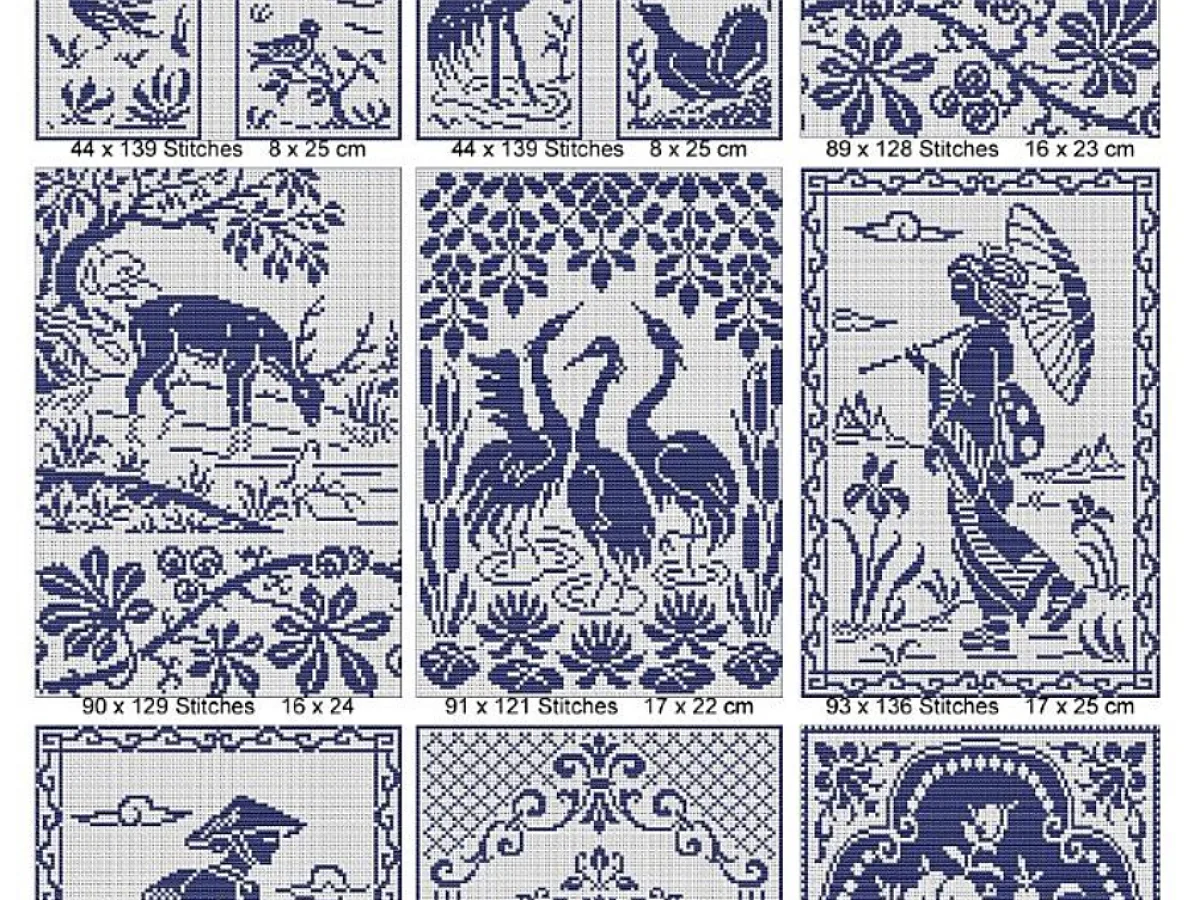
Here are five charts that work well in blue. Each one has a different shape, so you can practice reading filled and empty squares.
Start with the heart if you are new. It has clear curves and not too many rows. The flower and butterfly are a bit harder because they have more open spaces.
For each chart, count the starting chain from the bottom row. That number is usually written at the bottom of the chart.
How do you start a filet crochet project from a chart?
Look at the bottom row of the chart. Count the total number of squares, then multiply by the stitches each square needs. For a starting chain, you need three chains for each filled square and two for each empty square, plus three for the turning chain.
Example: a chart with 10 squares, all empty, needs 10 times 2 plus 3, which is 23 chains. If some are filled, add one extra chain for each filled square. Write that number down before you begin.
Work the first row from left to right, then the second from right to left. Keep the chart in front of you and mark each row as you finish.
Use a row counter or a piece of paper to track rows. Losing your place is the most common mistake, and it is easy to fix if you catch it early.
What are common filet crochet mistakes and how do you fix them?
The most common mistake is miscounting chains in a space. If the chart shows two empty squares, you need two chains, not one. Count the chains out loud as you make them.
Another mistake is turning the work the wrong way. Always read the chart from the same side as the row number. If your picture starts to look wrong, rip back to the last row you are sure about.
Finally, do not pull your chains too tight. Filet crochet needs loose chains so the spaces stay open. If your work curls, your chains are too tight.
If you find a mistake a few rows down, do not panic. You can drop down to the mistake and fix it with a crochet hook, but for beginners it is often faster to frog the row and redo it.
How do you finish and block a blue filet piece?
When you finish the last row, cut the yarn and weave in the ends. Then wet block the piece to open up the holes and make the pattern crisp.
Soak the piece in cool water with a drop of mild soap, then gently squeeze out the water. Pin it to a blocking mat or a towel in the shape you want, and let it dry completely.
Blocking makes a huge difference in filet. The spaces become even and the picture looks sharp. Do not skip it if you want a professional finish.
Use rust-proof pins for blocking. Regular pins can leave rust spots on your yarn.
Step
Choose your chart
Pick a chart with a shape you like. Start with a heart or a simple geometric pattern if you are new.
Gather supplies
Get your blue yarn, the right hook, and a printed chart. Have a row counter ready.
Make a foundation chain
Count the squares in the bottom row of the chart. Multiply empty squares by 2, filled squares by 3, add all together, then add 3 for the turning chain. Chain that number.
Work the first row
Double crochet in the fourth chain from the hook. Then follow the chart, working filled squares as 3 dc and empty squares as dc, ch 1, dc. Check your work against the chart row.
Continue row by row
Turn your work, chain 3 for the first dc, and read the next row from the chart. Mark each row as you finish to avoid losing your place.
Finish and weave in ends
When the chart is complete, cut the yarn and pull through the last loop. Weave in all loose ends with a yarn needle.
Block the piece
Soak in cool water, gently squeeze, and pin to shape. Let it dry completely before removing pins.
Ways to change it
Heart chart
A small, symmetrical shape that is perfect for beginners.
Flower chart
A bit more open, good for practicing spaces.
Butterfly chart
Uses both filled and open areas, a nice intermediate step.
Diamond or geometric chart
Repeating shapes make a good border or edging.
Letter or monogram chart
Personalize a bookmark or a wall hanging with an initial.
The short version
- Filet crochet uses a grid: filled squares are 3 dc, empty squares are dc, ch 1, dc.
- Blue yarn shows the pattern clearly because the holes contrast with the solid stitches.
- Cotton yarn and a matching hook give the best stitch definition.
- Always start with the bottom row of the chart and read each row in the direction shown.
- Count your chains carefully; a miscount in a space is the most common error.
- Blocking is essential to open up the spaces and make the design look sharp.
- You can use any chart, but blue filet charts are a classic choice for doilies and wall art.
Questions people ask
What does a filled square mean in filet crochet?
A filled square means you work three double crochet stitches into that space. It creates a solid block that forms part of the picture.
What does an empty square mean?
An empty square means you work a double crochet, a chain, and another double crochet. That makes an open mesh hole.
How much yarn do I need for a filet project?
It depends on the size of your chart and your yarn. A small bookmark might use 20 grams, while a doily could use 100 grams. Check the chart's stitch count for a rough idea.
Can I use any color yarn for filet crochet?
Yes, but light and medium colors show the pattern best. Dark colors can hide the holes, and very light colors may not give enough contrast.
Pick a chart and start crocheting
Blue filet crochet is a relaxing way to make something pretty with just one stitch. Grab a chart, some cotton yarn, and a hook, and you will have a finished piece before you know it. Keep it quick and cute!